
Starting music lessons is exciting—for children and parents alike.
It can also feel a little like stepping into a world where everyone suddenly speaks a different language. One week your child is talking about “tempo,” the next they’re proudly announcing that they played a “legato phrase” or finally mastered an “arpeggio.”
If you’re smiling and nodding while secretly wondering what any of those words mean, you’re certainly not alone.
Don’t worry—we won’t quiz you later.
This guide isn’t about turning parents into music teachers or preparing you for a theory exam. It’s simply a friendly cheat sheet to help you understand some of the words your child might excitedly use after lessons. Think of it as a translation guide that helps you feel a little more connected to your child’s musical journey.
The wonderful thing about music is that children learn the language naturally over time. Parents don’t need to memorize every term—they just need enough understanding to cheer their child on with confidence.
So relax. We’ve got you.
📖 We recommend bookmarking this page. As your child’s musical vocabulary grows, so will this glossary. Whenever you come across an unfamiliar term in a lesson book, recital program or conversation with a teacher, simply return here for a clear, parent-friendly explanation. We’ll continue expanding this resource with new terms over time.
A–Z Music Glossary for Parents
A — Accent
An accent is a note that receives a little extra emphasis. Think of it like putting extra expression on a particular word when you’re telling a story. It helps music sound lively and expressive instead of flat or robotic.
Your child may hear their teacher say, “Give that note an accent.” They aren’t asking your child to play loudly all the time. They simply want that particular note to stand out from the notes around it.
Accents can appear in music for almost any instrument, including piano, guitar, violin and voice. They help students move beyond simply playing the right notes and begin communicating the feeling of the music.
A — Accompaniment
An accompaniment is the musical part that supports the main melody.
Imagine a singer performing while someone plays piano or guitar underneath. The singer may carry the tune, while the accompaniment provides the musical foundation that makes the song feel complete.
As students progress through Piano Lessons, Guitar Lessons or Ukulele Lessons, they may learn to play both melodies and accompaniments. Understanding the difference also helps children listen more carefully when they hear multiple musical parts working together.
A — Amateur
An amateur musician is someone who plays, sings or studies music for the enjoyment of it rather than as a full-time profession.
The word comes from the Latin amator, meaning “lover.” In other words, an amateur is someone who loves what they do—not someone who lacks ability.
Many amateur musicians are exceptionally skilled and continue taking lessons, performing and enjoying music throughout their lives. While some OCOM students may one day choose a professional musical career, many more will simply develop a lifelong appreciation for music—and that’s a wonderful outcome too.
A — Arpeggio
An arpeggio is a chord in which the notes are played one after another instead of all at once.
If a chord is like pressing several elevator buttons at the same time, an arpeggio is pressing them one at a time. The notes still belong together, but they create a flowing pattern rather than one combined sound.
Students encounter arpeggios in piano, guitar and violin music. Practising them helps develop finger coordination, listening skills and a better understanding of how chords are constructed.
A — Audition
An audition is an opportunity for a musician to perform in order to be considered for a particular group, role or program.
While auditions can sound intimidating, they are simply another chance to share what you’ve learned. Depending on a student’s goals, auditions may be used for ensembles, choirs, musical theatre productions or advanced music programs.
Most beginners won’t encounter auditions right away. As your child’s skills and confidence grow, however, they may choose to audition for new musical opportunities. Preparation, practice and a positive attitude are far more important than striving for a flawless performance.
B — Bar (Measure)
A bar—also called a measure—is a small section of music separated by vertical lines.
Think of it like a sentence in a book. Music is much easier to read when it is divided into manageable sections instead of appearing as one endless stream of notes.
You may hear a teacher say, “Let’s start at bar eight,” or “Try that measure again.” Both instructions mean the same thing. The teacher is simply helping your child locate a particular section of the music.
B — Bass Clef
The bass clef is the symbol used for lower-pitched notes on the musical staff. On the piano, the left hand most often reads music written in the bass clef.
While the treble clef is used for higher notes, the bass clef covers the lower range of music. Together, the two clefs allow musicians to read a much wider range of notes than either could on its own.
Beginning piano students are often introduced to both clefs early in their lessons. It may seem confusing at first, but reading both soon becomes second nature with regular practice.
B — Beat
The beat is the steady pulse of music.
If you have ever tapped your foot, clapped your hands or nodded your head while listening to a favourite song, you were probably following the beat.
The beat helps musicians stay together and keeps the music moving at a consistent pace. It is one of the first concepts beginners learn because rhythm, note values and timing are all organized around it.
Parent Tip: Try clapping along with a familiar song at home. You don’t have to explain anything—the activity simply helps children feel the steady pulse naturally.
C — Chord
A chord is a group of notes played together.
Chords create much of the musical background underneath a melody. They can make music sound cheerful, dramatic, peaceful, tense or powerful depending on which notes are used.
Students in Piano Lessons, Guitar Lessons and Ukulele Lessons spend plenty of time learning chords because they are the building blocks of thousands of songs. Once students know a few basic chords, they may be surprised by how much music they can already play.
C — Clef
A clef is the symbol at the beginning of a line of music that helps musicians identify the notes on the staff.
The two clefs parents are most likely to encounter are the treble clef and bass clef. Piano students often read both, while many other beginners begin mainly with the treble clef.
You do not need to memorize how every clef works. Just think of it as the legend on a map: it gives musicians the information they need to understand everything that follows.
C — Crescendo
A crescendo means that the music gradually becomes louder.
Rather than suddenly increasing the volume, the musician slowly builds the sound. A crescendo can create excitement, anticipation or a sense that the music is moving toward an important moment.
It is one of those musical words that sounds highly technical but describes something we naturally recognize when listening to music. Children learn to create crescendos through careful control rather than simply playing as loudly as possible.
D — Dynamics
Dynamics describe how loudly or softly music should be played or sung.
Music without dynamics would sound a little like someone reading every sentence in exactly the same voice. The words might be correct, but the story would lose much of its feeling.
Teachers often encourage students to think beyond playing the correct notes. Learning to control volume helps young musicians communicate emotion, shape musical phrases and make performances more interesting to hear.
D — Duet
A duet is a piece of music performed by two musicians together.
For beginners, duets are often played with a teacher or another student. This allows young musicians to experience making music with someone else while building confidence and learning to listen carefully.
Parents are often surprised by how much children enjoy duet playing. It teaches teamwork, strengthens rhythm and timing, and reminds students that music is something to be shared—not just practised alone.
E — Ensemble
An ensemble is a group of musicians performing together.
An ensemble might be a band, orchestra, choir, duet or small group of instrumentalists. The exact size does not matter. What matters is that several people are listening and responding to one another as they make music.
Students participating in OCOM’s Bands & Combos program learn how their individual part contributes to the overall performance. They also develop teamwork, confidence and the ability to keep going even when someone else plays an unexpected note.
Parent Tip: Playing in an ensemble is a lot like being on a sports team. Everyone has a role, and success comes from working together.
F — Fermata
A fermata is a musical symbol that tells the performer to hold a note or rest a little longer than its written value.
Think of it as music’s way of saying, “Don’t rush this moment.” The exact length isn’t measured by counting—it depends on the style of the music and the teacher or conductor’s direction.
Children often enjoy spotting fermatas because they’re easy to recognize. When your child excitedly says, “I got to hold that note really long,” there’s a good chance they just discovered a fermata.
F — Flat
A flat (♭) tells a musician to play a note slightly lower than its usual pitch.
Parents do not need to worry about the precise musical distance involved. The important thing to understand is that the flat symbol changes the note your child should play.
At first, flats can look like one more mysterious symbol added to an already busy page. With repetition, students gradually begin to recognize them automatically—just as young readers eventually stop sounding out every individual letter.
F — Forte
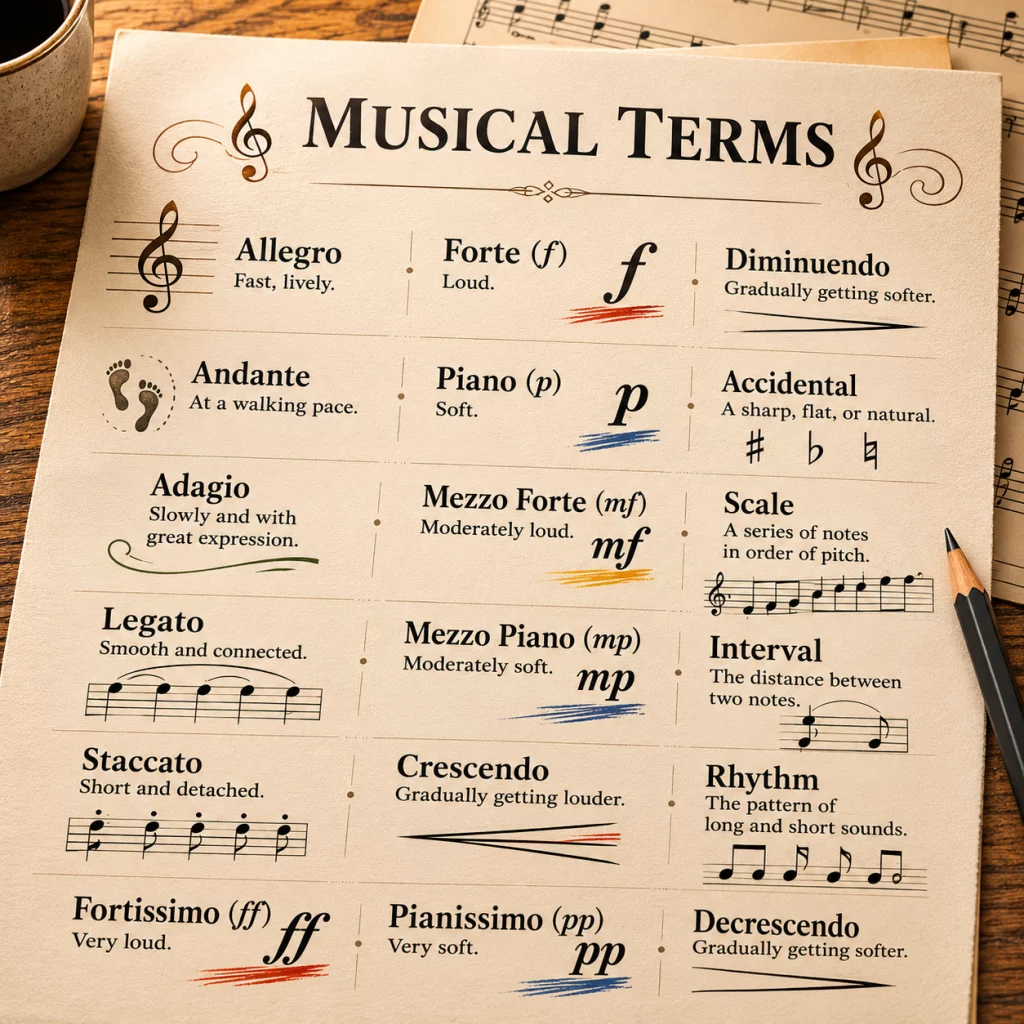
Forte (f) is the Italian word for loud. When students see an f in their music, they should play or sing with more volume—but still with good control and a pleasant tone.
F — Fortissimo
Fortissimo (ff) means very loud. Musicians should play with energy and confidence, but never at the expense of good technique or a beautiful sound.
G — Grand Staff
The grand staff is the pair of musical staffs commonly used in piano music. It usually includes a treble clef on top and a bass clef underneath, connected by a line or brace.
In simple terms, it allows pianists to read music for both hands at the same time. The upper staff often contains notes played by the right hand, while the lower staff often contains notes played by the left.
It can look intimidating when a new piano student first sees it, but teachers introduce it gradually. Your child is not expected to process every note instantly on day one.
H — Harmony
Harmony happens when different notes sound together in a way that supports or enriches the melody.
If the melody is the main character in a movie, harmony is the supporting cast that gives the story greater depth. You may notice harmony when two singers perform different notes at the same time or when a pianist plays chords beneath a melody.
Students studying OCOM’s Harmony program explore these musical relationships in greater detail. However, even young beginners experience harmony whenever they play with a teacher, perform with another student or add chords beneath a tune.
I — Improvisation
Improvisation is the art of creating music spontaneously rather than playing notes exactly as they are written.
Think of it as having a musical conversation. Instead of reading from a script, musicians use the skills they’ve learned to invent melodies, rhythms and musical ideas in the moment.
Improvisation helps students build creativity, confidence and a deeper understanding of music. There are no “perfect” improvised performances—the goal is to experiment, listen and express ideas through sound.
I — Interval
An interval is the distance between two notes.
Think of it as measuring the space between two stepping stones. Some intervals place the notes very close together, while others create a much larger musical jump.
Recognizing intervals can help students read music, sing accurately and understand how melodies are constructed. Children encounter them naturally during instrument lessons, Vocal Training and Theory classes. They do not need to memorize every interval immediately; the names and sounds become more familiar through practice.
J — Jam Session
A jam session is an informal opportunity for musicians to play together, experiment and enjoy making music without following a highly structured performance plan.
During a jam session, one musician might begin playing a chord pattern while others add a melody, rhythm or improvised part. It gives students a chance to listen, respond and become more comfortable playing with other people.
Jam sessions are especially relevant to students participating in Bands & Combos. They remind children that music is not only about exams, exercises and carefully polished pieces—it can also be creative, social and fun.
K — Key Signature
The key signature appears near the beginning of a piece of music and tells musicians which notes will usually be played sharp or flat throughout the piece.
Think of it like reading the important instructions at the top of a recipe. Once you know which ingredients are being used, the recipe does not need to repeat the same reminder on every line.
Students learn to recognize key signatures gradually through their instrument lessons and Theory studies. Parents do not need to decode them—the important thing is knowing that they help organize the sound of the music.
L — Legato
Legato means playing or singing smoothly, with one note flowing into the next.
Imagine drawing one long, graceful line instead of a series of separate dots. Legato helps music sound connected and expressive.
Students in Piano Lessons, Violin Lessons and Vocal Training frequently work on legato. The physical technique differs from one instrument to another, but the musical goal is the same: creating a continuous, flowing sound without unnecessary gaps between notes.
M — Measure
A measure is another word for a bar. It is a section of music separated by vertical lines.
Teachers use measure numbers to help students locate a precise place in a piece. For example, “Start at measure twelve” is much clearer than “Start somewhere around the middle, near those notes that go up and then down.”
You may hear the words “bar” and “measure” used interchangeably. There is no hidden difference for parents to remember—they refer to the same basic division of written music.
M — Melody
The melody is the main tune—the part people usually remember, sing or hum afterward.
In a familiar song, the melody is often the part carried by the singer or played by the lead instrument. Chords, rhythms and accompaniment support it, but the melody usually provides the most recognizable musical idea.
When your child says, “I learned the melody today,” they generally mean they learned the tune that listeners would recognize most easily.
M — Metronome
A metronome produces a steady click or pulse that helps musicians maintain consistent timing.
Think of it as music’s version of a very patient clock that never gets tired of reminding everyone to stay on beat.
Many students are not immediately thrilled to practise with one. The metronome has an inconvenient habit of revealing whenever someone speeds up through the easy parts or slows down through the difficult ones. However, regular metronome practice helps students develop control, accuracy and a dependable internal sense of timing.
Parent Tip: Practising with a metronome is a little like practising free throws before a basketball game. It builds consistency that pays off later.
M — Mezzo Forte
Mezzo forte (mf) means moderately loud. It’s one of the most common dynamic markings students encounter and indicates a comfortable, balanced playing volume.
M — Mezzo Piano
Mezzo piano (mp) means moderately soft. It sits between loud and quiet, encouraging students to play gently without becoming difficult to hear.
N — Natural
A natural (♮) cancels a sharp or flat and returns a note to its usual pitch.
You can think of it as a musical reset button. If a note was previously raised by a sharp or lowered by a flat, the natural symbol tells the musician to play the regular version of that note again.
The symbol may be unfamiliar at first, but it completes a useful trio: sharps raise notes, flats lower notes and naturals return them to normal. Students gradually learn to spot all three while reading music.
O — Octave
An octave is the distance between one note and the next higher or lower note with the same name.
For example, a piano contains several different C notes. They are not identical in pitch—some are much higher or lower—but they sound closely related. The distance from one C to the next C is an octave.
Children do not need to memorize the science behind octaves. They simply learn to use them as helpful landmarks when navigating a piano keyboard, finding notes on an instrument or exploring the range of their voice.
P — Perfect Pitch
Perfect pitch is the rare ability to identify or sing a musical note without first hearing a reference note.
It often captures people’s imagination, but it’s also one of the most misunderstood musical abilities. While fascinating, perfect pitch is not a requirement for becoming an accomplished musician.
The vast majority of excellent musicians—including many professionals—develop outstanding musical skills through careful listening, regular practice and strong ear training. Encouragement and consistency will always have a much greater impact on your child’s musical growth than whether they possess perfect pitch.
P — Phrase
A phrase is a musical idea that feels like a complete thought.
Just as we naturally pause between sentences when speaking, musicians shape music into phrases. A phrase may rise, fall, build toward an important note or end with a brief pause.
Teachers encourage students to recognize phrases because music should sound like communication—not like someone reading every word without taking a breath. Understanding phrasing helps children play with more expression and gives listeners a clearer sense of where each musical idea begins and ends.
P — Pianissimo
Pianissimo (pp) means very soft. Performing quietly while maintaining good tone and control is often more challenging than playing loudly.
P — Piano
Piano (p) is the Italian word for soft. It tells musicians to reduce their volume while maintaining a clear, expressive sound.
P — Pitch
Pitch describes how high or low a sound is.
A small bird’s chirp has a relatively high pitch, while a large drum produces a lower one. In music, students learn to recognize, reproduce and compare different pitches.
Students in Vocal Training spend time learning to match pitch accurately, while instrumental students develop the same listening skill as they play. Pitch improves through practice and careful listening. A child does not need “perfect pitch” to become an excellent musician.
Q — Quarter Note
A quarter note is one of the basic note values children encounter when learning rhythm. In many beginner exercises, it receives one beat.
If your child counts “one, two, three, four” while playing one note on each number, they may be practising quarter notes.
The exact value of a quarter note depends on the time signature, but parents do not need to get buried in the details. What matters is that note shapes help musicians understand how long each sound should last. Quarter notes are among the first rhythmic building blocks most young students learn.
R — Rest
A rest tells musicians not to play or sing for a specific amount of time.
Yes, silence is actually written into music—and it is just as important as the notes themselves.
Rests give music room to breathe. They help create rhythm, separate ideas and build anticipation before the next sound begins. Students must learn to count rests carefully rather than simply treating them as permission to stop paying attention. Sometimes staying silent at exactly the right moment requires just as much concentration as playing a note.
R — Recital
A recital is a performance where students have the opportunity to showcase what they’ve been learning.
For many children, a recital is their first experience performing in front of an audience. It can be exciting, nerve-racking and incredibly rewarding all at the same time.
At OCOM, recitals give students a chance to build confidence, celebrate their progress and share their music with family and friends. Remember, the goal isn’t perfection—it’s growth, experience and enjoying the accomplishment of performing.
R — Rhythm
Rhythm describes the pattern of long sounds, short sounds and silences within the steady beat.
The beat is the regular pulse underneath the music, while rhythm is the changing pattern that happens on top of it. If the beat is your heartbeat, rhythm is the way you walk, run, skip or dance.
Children develop rhythm through counting, clapping, movement and playing their instrument. Strong rhythm skills help students perform confidently on their own and stay together when playing in an ensemble.
S — Scale
A scale is a sequence of notes played in a particular order, usually moving gradually higher or lower.
Students practise scales because they help develop technique, finger coordination, listening skills and familiarity with the notes used in different pieces of music.
Scales are not always the most exciting part of practice, but they make many other musical tasks easier. A student who becomes comfortable playing scales is often better prepared to recognize patterns and navigate more complicated music.
Parent Tip: Think of scales like warm-ups before a hockey game or soccer practice. They may not be the main event, but they prepare students for everything that follows.
S — Sharp
A sharp (♯) tells a musician to play a note slightly higher than its usual pitch.
Like flats and naturals, sharps are symbols that change which note the student should play. They appear in individual measures and in key signatures.
Do not worry if you cannot instantly recognize or explain them. Your child’s teacher will introduce sharps gradually, and students become more comfortable with them through repetition. What initially looks like a tiny hashtag on the page eventually becomes a familiar musical instruction.
S — Sight Reading
Sight reading means playing or singing a piece of music that you have not practised before.
It is similar to reading a page from a new book aloud for the first time. A child may pause, make mistakes or need time to process what comes next. That is normal.
Sight reading helps students become more independent musicians because they learn to recognize notes, rhythms and patterns without relying entirely on memory. Like ordinary reading, it becomes easier and more fluent through regular practice.
S — Staff
The staff is the set of five horizontal lines on which musical notes and symbols are written.
Think of it as the space where written music lives. The position of a note on or between the lines helps the musician determine which pitch to play.
At first, the staff may seem like a complicated collection of dots and lines. As students learn a few notes at a time, it begins to function more like a familiar map than a mysterious code.
S — Staccato
Staccato means playing short, separate notes.
Instead of flowing smoothly together like legato notes, each staccato note is crisp and detached from the next. Teachers sometimes compare the sound to gently bouncing a ball rather than sliding it across the floor.
On different instruments, students use different techniques to create staccato. A pianist may release each key quickly, while a violinist uses short bow movements. The result should sound light and clearly separated—not angry or aggressively chopped.
T — Tempo
Tempo tells musicians how fast or slowly a piece should be played.
Some music has a lively, energetic tempo, while other pieces are calm and unhurried. Students may see traditional Italian tempo words in their music, but teachers often explain them using familiar language such as slow, moderate or fast.
Maintaining a steady tempo is an important skill. Young musicians sometimes speed through easy sections and slow down when the music becomes difficult. Careful practice—and that endlessly patient metronome—helps correct this tendency.
T — Time Signature
The time signature appears near the beginning of a piece and tells musicians how the beats are grouped into measures.
It usually looks like one number placed above another. A common time signature is 4/4, which often means there are four quarter-note beats in each measure.
Parents do not need to memorize the mathematical details. Think of the time signature as a set of organizational instructions. It helps musicians count consistently and understand where the strong and weak beats are likely to fall.
T — Treble Clef
The treble clef is the curled symbol that appears at the beginning of many lines of music. It tells musicians which notes are represented on the staff.
Many instruments, including piano (for the right hand), violin, flute and many vocal parts, regularly use the treble clef. Students become familiar with it very early in their musical journey.
Parents don’t need to learn to read every note themselves. Simply recognizing the treble clef can make sheet music feel a little less intimidating and help you follow along as your child learns.
U — Unison
Unison means that two or more musicians are playing or singing the same melody at the same pitch—or at closely related pitches in different octaves.
You may hear this term during Vocal Training, group violin instruction or Bands & Combos. When everyone performs in unison, the goal is to sound like one coordinated musical voice rather than several separate individuals.
Playing in unison helps students practise listening, matching pitch and staying together rhythmically. It can sound simple, but achieving a clean, unified result requires attention and teamwork.
V — Viscount
Viscount is the digital piano brand most commonly associated with OCOM today. Many students begin their musical journey on a Viscount instrument, making it a familiar name around the Conservatory.
If you’re shopping for your child’s first piano, you may hear teachers or staff mention Viscount as one of the available options. Digital pianos offer many advantages for beginners, including realistic key action, built-in sounds and the ability to practise quietly with headphones.
The most important thing isn’t the name on the piano—it’s having an instrument that encourages regular practice and makes your child excited to sit down and play.
V — Volume
Volume refers to how loud or soft a sound is. In formal musical language, teachers are more likely to use the word dynamics, but younger students may hear both terms.
Controlling volume is not simply a matter of playing loudly or quietly. Students learn to adjust their sound gradually, create contrast and choose a level that suits the character of the music.
For parents, the main thing to remember is that “play louder” does not mean “attack the instrument,” and “play softly” does not mean allowing the sound to disappear completely.
W — Whole Note
A whole note is a note value that lasts longer than a quarter note. In common 4/4 time, it is usually held for four beats.
A student might play the note on “one” and continue holding it while counting “two, three, four.” This helps children learn that playing music involves not only knowing when to begin a note, but also knowing how long to continue it.
Whole notes are often introduced early because their long duration makes counting easier to hear and feel. They also provide valuable practice in maintaining a steady sound.
X — Xylophone
A xylophone is a percussion instrument made from rows of tuned bars that are struck with small mallets.
Many children first encounter xylophones or similar instruments in school music programs. Unlike an untuned drum, each bar produces a specific musical pitch, allowing students to play melodies as well as rhythms.
The layout of the bars also resembles the pattern of black and white keys on a piano. This makes the xylophone a useful introduction to note relationships, coordination and the idea that percussion instruments can do much more than simply keep the beat.
Y — Young Chang
Young Chang is one of the world’s best-known acoustic piano manufacturers. Founded in South Korea in 1956, the company built its reputation by producing quality grand and upright pianos that have helped generations of students learn to play.
For many long-time OCOM families, the name Young Chang brings back memories of the acoustic pianos that have been part of the Conservatory’s history for decades. Don’t be surprised if you hear the name come up when discussing instruments or home practice.
Whether your child learns on a Young Chang acoustic piano or a Viscount digital piano, the instrument is simply the beginning. Consistent practice, encouragement and a love of music will always matter far more than the logo on the front.
Z — Zzzzz…
No, music lessons shouldn’t put anyone to sleep—but memorizing a long list of musical terms certainly might!
The good news is that you don’t need to remember everything in this glossary. Your child won’t learn all of these words overnight, and neither should you. Think of this page as a handy reference you can return to whenever your young musician starts using a new term at home.
By this time next year, you’ll probably be surprised by how many of these words feel completely familiar.
You Don’t Need to Know Everything
One of the biggest misconceptions about music lessons is that parents need a musical background to help their children succeed.
The truth is, you don’t.
The most valuable things parents can provide have very little to do with knowing musical terminology:
- Encouragement after each lesson.
- A consistent and realistic practice routine.
- Celebrating effort rather than expecting perfection.
- Listening when your child wants to perform.
- Asking questions about what they learned.
Even a simple question such as, “What did you work on today?” shows your child that their lessons matter. You do not need to correct their technique or explain the music. In many cases, asking your child to explain a new term can actually help them remember it.
Understanding a few musical words simply makes these conversations easier. It allows you to follow your child’s progress, recognize what they are practising and feel more involved in their learning.
As your child grows through Piano Lessons, Violin Lessons, Guitar Lessons, Vocal Training or Ukulele Lessons, you will naturally pick up more vocabulary along the way.
Students who continue their musical education may also explore programs such as Theory, Harmony, History or OCOM’s Assistant Teacher Training Program. These programs introduce more advanced ideas gradually, building on what students have already learned through their regular lessons.
No one expects parents to become music teachers.
Your job is simply to be your child’s biggest fan.
Final Thoughts
Music really is a journey for the whole family.
Your child will gradually learn new techniques, new songs and, yes, plenty of new vocabulary. Before long, many of these terms will feel surprisingly familiar to you too.
You may find yourself reminding your child to count the rests, recognizing when a song suddenly changes tempo or understanding why the metronome has started clicking from the practice room again.
For nearly 90 years, Ontario Conservatory of Music has welcomed families from a wide range of backgrounds. Some parents arrive with years of musical experience, while others have never read a single note. Both groups discover the same thing: children thrive when they feel encouraged, supported and excited to learn.
You don’t need to know every musical term.
You simply need to keep asking questions, celebrating progress and enjoying the music your child brings home.
The rest will come naturally.
Frequently Asked Questions
Do parents need musical experience for their child to take lessons?
Not at all. Teachers explain new concepts during lessons, and children learn gradually as they practise. Your encouragement, interest and consistency are much more important than your ability to read music or play an instrument.
Why do music teachers use so many unfamiliar words?
Like sports, dance and many other activities, music has its own vocabulary. These terms allow teachers and students to communicate clearly about sound, rhythm, expression and technique. The words may feel unfamiliar at first, but they gradually become part of your child’s everyday musical language.
Will my child learn all of these terms?
Yes, many of them—but not all at once. Teachers introduce terminology as it becomes relevant to the music a student is learning. Younger beginners may start with words such as beat, rhythm and tempo, while more advanced students gradually explore key signatures, harmony and intervals.
Is music theory separate from instrument lessons?
Instrument lessons naturally include basic theory as students learn notes, rhythms, scales and musical symbols. OCOM also offers dedicated Theory, Harmony and History programs for students who require or want a deeper understanding of how music works.
How can I help my child remember these terms?
Ask your child to explain one new word after each lesson. Children often remember an idea more clearly when they teach it to someone else. You can also connect terms to familiar experiences—for example, comparing scales to athletic warm-ups or musical phrases to sentences in a story.
What should I do when I don’t understand something my child is practising?
It is perfectly fine to say, “I’m not familiar with that—can you show me?” This gives your child an opportunity to demonstrate what they have learned. You can also make a note of the term and ask the teacher for clarification. Parents are not expected to know everything, and questions are always welcome.