
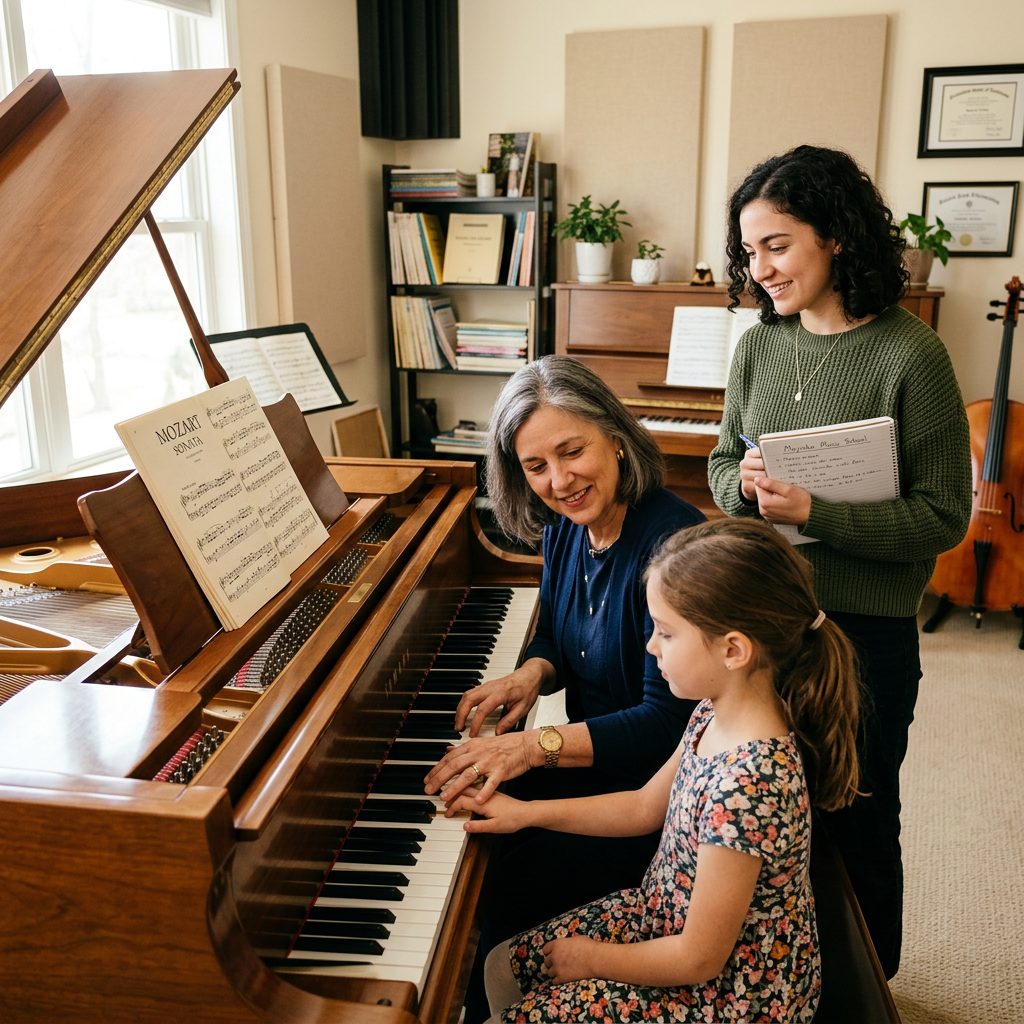
Every music teacher begins somewhere. Many start as students, learning their first notes, practising scales and discovering the satisfaction of playing a piece from beginning to end. Over time, some develop a deeper interest in music and begin wondering whether they could share that knowledge with others.
But becoming a music teacher involves more than learning to play an instrument well.
An accomplished musician may understand rhythm, harmony, technique and musical expression, yet still find it challenging to explain those concepts to someone encountering them for the first time. Teaching requires a different set of skills: communication, patience, planning, observation and the ability to adapt instruction to individual students.
For musicians considering a future in education, understanding that distinction is an important first step.
1. Being a Good Musician Is Not the Same as Being a Good Music Teacher
Musical proficiency provides the foundation for teaching, but it does not automatically translate into instructional ability.
Consider an experienced pianist who can perform a difficult passage effortlessly. A beginner may struggle to play the same passage slowly, even after watching a demonstration several times.
The teacher must recognize what is causing the difficulty. Is the student having trouble with finger placement, rhythm, hand coordination or understanding the notation?
Rather than simply repeating the demonstration, an effective instructor identifies the problem and introduces an explanation or exercise that addresses it.
This requires the ability to break complex musical ideas into manageable steps.
It also requires an understanding of how musical skills develop over time. As explored in Why Structured Music Education Produces Better Long-Term Results, consistent progression helps students build on existing knowledge rather than approaching each new concept in isolation.
For aspiring teachers, learning how to guide that progression is just as important as developing their own performance abilities.
2. A Strong Musical Foundation Comes First
Before someone can effectively teach music, they need a reliable understanding of the subject.
That foundation generally includes practical musicianship, music theory, rhythm, notation, listening skills and an awareness of how musical concepts connect.
Music theory is particularly valuable because it provides a language for explaining what students hear and play.
For example, understanding scales and chord relationships allows a teacher to explain why certain notes work together instead of asking students to memorize patterns without context.
Harmony adds another dimension. It helps musicians recognize relationships between notes and understand how different musical parts work together.
Our article, What Is Harmony in Music and Why Is It Important for Developing Musicians?, explores how this understanding contributes to musical development.
Music history can also enrich instruction by helping students understand the styles, traditions and composers behind the music they study.
The objective is not necessarily to become an expert in every musical discipline. It is to develop enough depth and breadth to explain concepts accurately and connect individual lessons to a larger musical education.
3. Communication Is One of a Music Teacher’s Most Important Skills
Teaching music means communicating with people who may have very different levels of knowledge, confidence and experience.
A teacher might work with a young beginner who has never touched an instrument, an older student preparing for an examination or an adult returning to music after many years.
Each student may require a different approach.
An explanation that makes perfect sense to an experienced musician could confuse a beginner. Similarly, an instructional style that motivates one student may discourage another.
Effective music teachers learn to:
Explain musical concepts using clear, age-appropriate language.
Demonstrate techniques without overwhelming students.
Recognize when an explanation is not working.
Offer constructive feedback that encourages improvement.
Communicate progress and expectations to parents or caregivers.
Listen carefully to students’ questions and concerns.
Communication also involves knowing when to stop talking and allow students to experiment.
Sometimes the most productive moment in a lesson occurs when a teacher asks a question and gives the student time to discover the answer.
4. Understanding How Students Learn
No two students develop musical skills in exactly the same way.
Some quickly recognize patterns in written music but struggle with rhythm. Others have excellent listening skills yet require additional time to understand notation. A student may perform confidently at home but become nervous when asked to play in front of others.
A capable teacher must observe these differences and adjust instruction accordingly.
This does not mean abandoning a structured curriculum. Rather, it means understanding how to deliver that curriculum effectively to individual learners.
For example, a student struggling with rhythm might benefit from clapping exercises before returning to the instrument. Another may understand a difficult passage more easily after hearing it performed.
Teachers also need to distinguish between a student who has not practised and one who genuinely does not understand the material.
Those situations require different responses.
Recognizing progress is equally important. As discussed in 5 Signs Your Child Is Making Real Progress in Music Lessons, improvement is not always measured by how quickly students advance to more difficult pieces.
Developing better listening habits, greater independence and stronger musical understanding can be equally meaningful indicators.
5. Lesson Planning Turns Musical Knowledge Into Education
An effective music lesson needs more than a collection of exercises.
Teachers must consider what students already know, what they are ready to learn and how each activity contributes to longer-term development.
A well-planned lesson may include reviewing previous material, introducing a new concept, demonstrating a technique, allowing guided practice and establishing realistic goals for the next session.
The challenge is balancing structure with flexibility.
A teacher may plan to introduce a new scale but discover that the student still needs help with a fundamental rhythm pattern. Continuing with the original plan simply to complete the lesson could leave the underlying problem unresolved.
Experienced instructors learn to recognize when to move forward and when to reinforce an existing skill.
They also learn how to connect lessons over time so students understand why they are learning particular techniques.
This is one of the important differences between delivering isolated music lessons and providing a comprehensive music education.
Our article, The Difference Between Music Lessons and Music Education — and How Both Have Changed Since 1939, examines that distinction in greater detail.
6. Patience, Encouragement and Constructive Feedback
Learning an instrument can be frustrating.
Students make mistakes, forget instructions, encounter difficult passages and sometimes lose confidence in their abilities.
Teachers must respond in ways that help students continue learning rather than become discouraged.
That requires patience, but patience alone is not enough.
An effective teacher also knows how to provide specific, actionable feedback.
Telling a student to “practise more” may not solve the problem. Explaining which measures need attention, demonstrating a slower tempo and suggesting a manageable practice routine gives the student something useful to work on.
Encouragement should also be meaningful.
Rather than offering praise for every attempt, teachers can recognize genuine improvements in timing, technique, concentration or musical expression.
This helps students understand that progress comes through effort and learning, not simply through approval.
Over time, the relationship between teacher and student can become an important source of motivation and confidence.
7. Practical Teaching Experience Matters
Reading about teaching techniques is valuable, but applying those techniques with real students introduces challenges that cannot always be anticipated.
A lesson may take longer than expected. An explanation may need to be simplified. A student may ask an unexpected question or struggle with something the teacher considers straightforward.
Practical experience allows aspiring instructors to develop judgment and confidence.
This is one reason apprenticeship and supervised teaching experiences can be valuable components of teacher preparation.
Working alongside experienced instructors provides opportunities to observe different teaching styles, understand classroom routines and receive feedback on instructional approaches.
It also helps prospective teachers recognize that effective teaching is a skill developed through practice.
Just as musicians refine their playing through repetition and constructive criticism, teachers improve by reflecting on their lessons and adjusting their methods.
8. Professional Development Does Not End When Teaching Begins
Music education continues to evolve, and effective teachers continue learning throughout their careers.
New instructional resources, teaching methods and technologies can provide additional ways to explain concepts or engage students.
Teachers may also expand their knowledge of different musical styles, pursue advanced studies or develop greater expertise in particular areas of instruction.
Professional development can include mentorship, additional coursework, classroom observation and the study of educational techniques.
It can also involve improving communication with families, developing stronger organizational skills and learning how to manage different classroom environments.
Importantly, continued development does not suggest that a teacher’s original training was inadequate.
It reflects the reality that teaching, like musicianship, is a discipline that benefits from ongoing refinement.
9. Exploring Music Teacher Training at Ontario Conservatory of Music
For musicians interested in developing their instructional abilities, formal teacher training can provide a more structured introduction to the profession.
Ontario Conservatory of Music offers an Assistant Teacher Training Program that addresses several important aspects of music instruction.
According to OCOM’s program information, training components include formal apprenticeship, classroom teacher training instruction, manuals and training materials, communication skills, successful teaching techniques, personal and professional development, and accreditation.
Together, these areas reflect an important principle: effective music teaching requires both subject knowledge and the ability to help other people learn.
The program is relevant to individuals interested in becoming music teachers as well as existing teachers seeking to strengthen their instructional skills.
Prospective participants should contact Ontario Conservatory of Music directly for current information about eligibility, program structure, accreditation and enrolment.
For musicians considering teaching as a career, understanding the training available is a useful starting point.
10. Is Music Teaching the Right Career Path?
Not every accomplished musician wants to become a teacher, and that is perfectly reasonable.
Performing and teaching offer different kinds of satisfaction.
Some musicians are most fulfilled by developing their own abilities, performing for audiences or composing original work. Others discover that helping someone else understand a difficult concept can be just as rewarding as mastering it themselves.
Aspiring teachers may want to consider several questions:
Do I enjoy explaining musical ideas to others?
Can I remain patient when someone needs repeated instruction?
Am I comfortable adapting my approach to different personalities and abilities?
Do I find satisfaction in another person’s progress?
Am I willing to continue developing my own musical and teaching skills?
A genuine interest in helping others learn is an important starting point.
However, enthusiasm should be supported by musical knowledge, practical preparation and a willingness to improve.
Teaching music is not simply about passing along information. It is about helping students develop skills, confidence, understanding and an appreciation of music that may remain with them for years.
Frequently Asked Questions About Becoming a Music Teacher
Do you need to be an expert musician to teach music?
Music teachers need sufficient musical knowledge and practical ability to teach their subject accurately. However, advanced performance skills alone do not guarantee effective teaching. Communication, lesson planning, patience and instructional techniques are also essential.
Is music theory important for aspiring teachers?
Yes. Music theory helps teachers explain rhythm, notation, scales, chords and other musical relationships. It provides a foundation for answering students’ questions and connecting practical exercises to broader musical concepts.
Can an experienced musician become a music teacher without teaching experience?
Musical experience is a valuable starting point, but new instructors still need to develop teaching skills. Training, mentorship, observation and supervised practical experience can help musicians learn how to communicate effectively and structure lessons.
What skills are most important for music teachers?
In addition to musicianship, important skills include communication, patience, observation, organization, lesson planning, adaptability and the ability to provide constructive feedback.
Does Ontario Conservatory of Music offer music teacher training?
Yes. Ontario Conservatory of Music offers an Assistant Teacher Training Program that includes apprenticeship, classroom instruction, communication skills, teaching techniques and professional development. Interested individuals should contact OCOM for current program details and eligibility requirements.
From Learning Music to Helping Others Learn
The journey from music student to music teacher is not simply a progression toward greater technical ability.
It involves learning to see music from another person’s perspective.
A successful teacher understands the subject, recognizes how students develop, communicates clearly and knows how to transform musical knowledge into meaningful instruction.
For musicians who enjoy helping others grow, teaching can offer an opportunity to make a lasting contribution to music education.
Whether someone is exploring teaching for the first time or looking to strengthen existing instructional skills, thoughtful preparation and continued learning provide a strong foundation.
Interested in exploring music education or teacher training? Discover the programs offered by Ontario Conservatory of Music or get started with OCOM to learn more about available opportunities.