
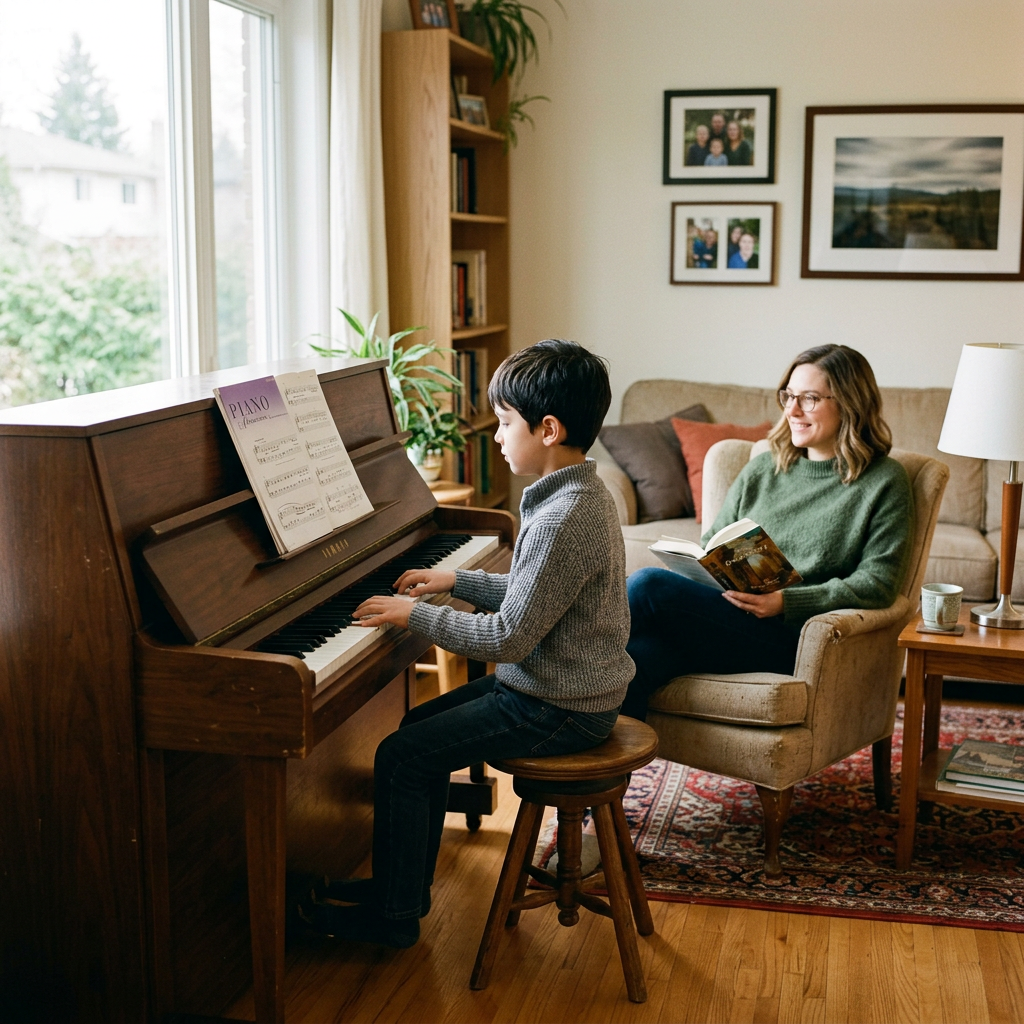
For many families, one of the biggest challenges of music lessons happens between appointments with the teacher. A child may enjoy learning piano, guitar or violin but still resist sitting down to practise at home.
Parents often find themselves asking the same questions: Have you practised today? When are you going to practise? Didn’t your teacher ask you to work on that piece?
Eventually, what began as an enjoyable educational activity can become a source of frustration.
The good news is that supporting music practice at home does not have to involve constant reminders, lengthy sessions or arguments about motivation. Often, the most effective approach is to establish manageable routines, create a supportive environment and help children understand what they are working toward.
Learning an instrument requires repetition, patience and consistent effort. However, children do not automatically develop independent practice habits simply because they begin taking lessons. Those habits develop gradually, with guidance from parents and instructors.
At Ontario Conservatory of Music (OCOM), structured music education emphasizes consistent progress and the development of strong musical foundations. Parents play an important supporting role, particularly during the early stages of learning.
Understanding how to motivate kids to practise music begins with recognizing that the goal is not simply to make children practise today. It is to help them develop habits that make practising easier tomorrow.
1. Make Music Practice Part of a Predictable Routine
One of the simplest ways to reduce repeated reminders is to establish a regular practice time.
When practice happens at a different time every day, children may begin treating it as an optional activity that can always be postponed. A predictable routine removes some of that uncertainty.
For example, a family might schedule music practice shortly after school, before dinner or following a short break from homework.
The best time depends on the child’s age, energy level and other commitments.
Rather than insisting on a particular hour, parents should look for a time that can be maintained consistently.
A successful routine might involve:
- Practising at approximately the same time each day.
- Keeping instruments and lesson materials easily accessible.
- Allowing a short break before practice when needed.
- Using a simple schedule or visual reminder.
- Adjusting the routine when school or family commitments change.
For younger children, a parent may still need to help initiate the routine. Over time, however, the goal is for practice to become a familiar part of the day rather than a repeated negotiation.
Consistency matters more than finding a theoretically perfect schedule.
2. Set Realistic Practice Expectations
Parents sometimes assume that longer practice sessions automatically produce better results.
In reality, the quality and consistency of practice are often more useful than the total number of minutes spent at an instrument.
A beginner who practises attentively for a short period may accomplish more than a student who sits at the piano for half an hour while distracted.
Practice expectations should reflect the student’s age, experience, attention span and current lesson material.
For example, a young beginner may benefit from several short sessions throughout the week. An older or more experienced student may be ready for longer, more independent practice.
The instructor can help families establish appropriate expectations.
Parents should also remember that not every practice session will be equally productive. Some days, a student may make noticeable progress. On others, the achievement may simply be reviewing familiar material or maintaining a routine.
Both can contribute to long-term development.
For more detailed guidance, parents can explore OCOM’s article How Much Should Children Practice Piano? A Parent’s Guide.
3. Help Children Understand What They Should Practise
Sometimes children resist practice because they are unsure what to do once they sit down.
A vague instruction such as “go practise your piano†places considerable responsibility on a young student.
They must remember what the teacher assigned, decide where to begin and determine whether they are making progress.
A more structured approach can make the task feel manageable.
Parents can help children review their lesson assignments and divide practice into specific activities.
For example, a beginner’s practice session might include:
- Reviewing a familiar warm-up or technical exercise.
- Practising a short section of a new piece.
- Working on a rhythm or note-reading activity.
- Playing something the student already enjoys.
This structure gives the student a clear beginning and end.
It also helps parents provide encouragement without needing advanced musical knowledge.
Instead of asking whether the child has practised enough, a parent can ask whether they completed the activities their teacher recommended.
The emphasis shifts from time spent to purposeful learning.
4. Give Children Some Control Over Their Practice
Children are more likely to participate willingly when they have some appropriate choices.
This does not mean allowing them to decide whether assigned practice is necessary. Instead, parents can offer flexibility within established expectations.
For example, a child might choose whether to practise before or after dinner, which assigned piece to begin with or whether to finish by playing a favourite song.
These decisions give students a sense of participation in the process.
As children become more experienced, they can gradually take greater responsibility for organizing their own practice.
A beginner may need a parent to review the assignment sheet and help establish the routine. An older student may be ready to plan their practice sessions independently and report on what they accomplished.
The amount of independence should increase as the student demonstrates readiness.
The long-term objective is to develop musicians who understand how to practise effectively without depending on someone else to direct every step.
5. Focus on Progress Rather Than Perfection
Learning music involves mistakes.
Students may play incorrect notes, lose their place, struggle with rhythm or repeat the same difficult passage many times.
These challenges are a normal part of developing musical skills.
Parents can help by recognizing effort and improvement rather than expecting every practice session to sound polished.
For example, instead of saying, “You still haven’t learned that song,†a parent might observe, “That section sounds more confident than it did last week.â€
Specific encouragement helps children recognize progress that might otherwise go unnoticed.
It is also useful to celebrate smaller achievements, such as learning a difficult rhythm, remembering a new musical symbol or playing a passage with fewer interruptions.
These accomplishments may seem minor compared with performing an entire piece, but they represent important steps in the learning process.
Parents can learn more about recognizing meaningful progress in music lessons.
6. Avoid Turning Every Practice Session Into a Performance
When a child sits down to practise, parents may naturally want to hear what they have learned.
However, practice and performance serve different purposes.
During a performance, students demonstrate material they have prepared. During practice, they are still learning.
That means stopping, repeating passages, experimenting and making mistakes are all expected.
A child who feels that every practice session is being evaluated may become reluctant to work on difficult material.
Parents can support a more comfortable environment by allowing students to practise without constant commentary.
They can still show interest by asking what the child is learning or inviting them to share a favourite piece after the session.
The distinction is important: practice is where students work through challenges, not where they must prove they have already mastered everything.
This approach helps preserve the value of independent learning while maintaining positive parental involvement.
7. Create a Practice Environment That Encourages Participation
The physical environment can influence how easily children settle into practice.
An instrument located in a busy area with frequent interruptions may make concentration difficult.
Similarly, a student who must unpack equipment, locate missing music books and rearrange furniture before every session faces unnecessary obstacles.
A practical music practice area does not need to be elaborate.
Ideally, it should provide:
- A suitable instrument in working condition.
- Comfortable seating and appropriate positioning.
- Adequate lighting.
- Easy access to sheet music and lesson materials.
- Reasonable freedom from distractions.
- Enough space for safe and comfortable playing.
For instruments such as piano or keyboard, accessibility is especially important. If the instrument is ready to use, beginning a short practice session becomes easier.
Families should choose an arrangement that works within their available space.
The objective is to make practising convenient, not to create a professional music studio at home.
8. Know When to Step Back and When to Ask the Teacher for Help
Parental involvement is valuable, but it should change as children develop.
Young beginners often benefit from assistance establishing routines and understanding assignments.
As students become more independent, parents can gradually reduce direct supervision.
However, repeated resistance to practice may indicate that something needs attention.
A child might be struggling with material that feels too difficult, becoming bored with familiar exercises or finding it challenging to balance music with other commitments.
Rather than responding with additional reminders, parents can speak with the instructor.
Questions worth discussing include:
- Is the assigned material appropriate for the student’s current ability?
- Does the student understand how to practise independently?
- Would shorter or more focused sessions be beneficial?
- Is the student progressing at a reasonable pace?
- Are there opportunities to introduce additional musical variety?
An experienced instructor can help identify practical adjustments.
This is one reason structured music education involves more than simply assigning new songs each week. Teachers help students develop the skills and habits needed for continued learning.
For families with a new student, understanding what to expect during the first year of music lessons can also help set realistic expectations.
9. Keep the Long-Term Purpose of Music Education in Mind
Most parents do not enrol their children in music lessons simply to complete a daily practice requirement.
They want their children to develop musical skills, experience the satisfaction of learning and discover an activity that may remain meaningful for years.
Consistent practice supports those goals, but it should not become the only measure of success.
Students also benefit from learning music theory, developing listening skills, participating in group activities and experiencing performance opportunities.
These elements help connect individual practice to a broader educational purpose.
For example, a student preparing for a group performance may better understand why maintaining a steady rhythm matters. Another student learning harmony may begin recognizing familiar chord patterns in their favourite songs.
When children understand how practice contributes to something meaningful, they may find it easier to remain engaged. Learn more about the benefits of playing music with others.
OCOM’s approach to music education combines structured instruction with opportunities to develop musical understanding and practical skills.
For parents, the most useful role is often to provide encouragement, maintain reasonable expectations and work with instructors to support steady progress.
Frequently Asked Questions
How can I get my child to practise music without arguing?
Start by establishing a predictable routine and agreeing on realistic expectations. Give your child some choices about when to practise or which assigned activity to begin with. Keep sessions manageable and focus on completing specific learning tasks rather than simply watching the clock. If practice regularly leads to arguments, speak with the instructor to determine whether the assignments, schedule or expectations need adjustment.
Should parents sit with their children during music practice?
Younger beginners may benefit from having a parent nearby to help them remember assignments and remain focused. However, parents do not need to supervise every note or correct every mistake. As children become more comfortable practising independently, parental involvement can gradually decrease. The goal is to provide enough support for successful learning while helping students develop responsibility for their own progress.
What should I do if my child refuses to practise?
First, try to understand why the child is resisting. They may be tired, frustrated by difficult material, unsure what to practise or overwhelmed by other activities. A short conversation can help identify the issue. Parents should also discuss persistent difficulties with the music teacher. Adjusting the practice routine, clarifying assignments or introducing appropriate variety may help make practice more manageable. For further guidance, see why students quit music lessons and how parents can help.
Is practising every day necessary for beginners?
Regular practice is important, but the ideal frequency and duration depend on the student’s age, experience and educational goals. For many beginners, shorter, consistent sessions are more manageable than occasional lengthy sessions. Teachers can recommend an appropriate schedule based on the material being studied. Parents should focus on developing a sustainable routine rather than treating a missed day as a major setback.
How can I tell whether my child is practising effectively?
Effective practice involves more than playing through familiar songs. Students should work on assigned material, identify challenging passages and make gradual improvements in accuracy, rhythm or technique. Parents can ask children what they are working on and what has improved since the previous lesson. Feedback from the instructor is also valuable, particularly when determining whether practice habits are supporting appropriate progress.
Helping Children Build Lasting Practice Habits
Supporting music practice at home does not require parents to become instructors or spend every evening reminding children to play their instruments.
The most effective approach is usually a combination of consistent routines, realistic expectations, purposeful assignments and positive encouragement.
As children develop their skills, they can gradually take greater responsibility for their own learning.
Understanding how to motivate kids to practise music is ultimately about helping them recognize the value of steady effort and making music a sustainable part of their lives.
At Ontario Conservatory of Music, structured instruction provides students with clear educational goals while helping families understand how to support progress between lessons.
Parents interested in learning more can explore OCOM’s music programs or get started with Ontario Conservatory of Music to discuss suitable learning opportunities.