
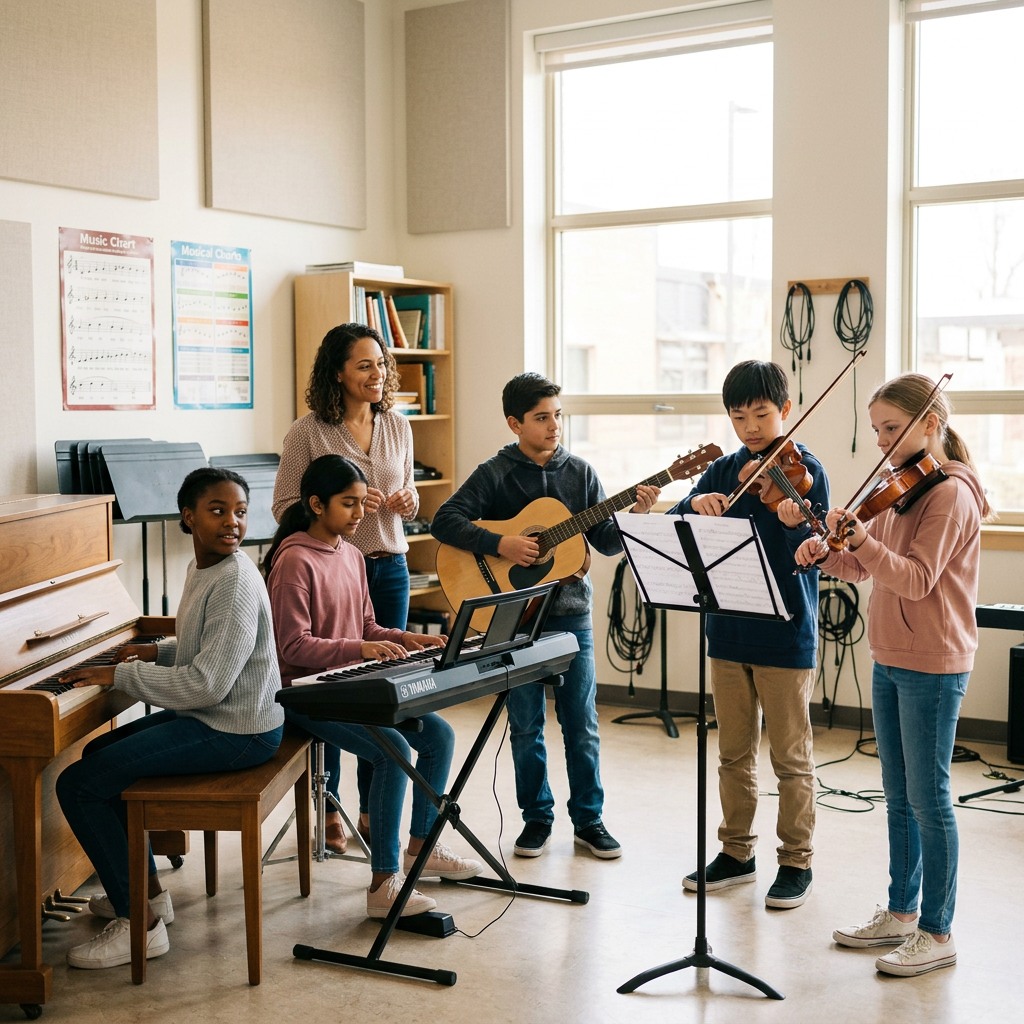
Learning to play an instrument often begins as an individual experience. Students practise notes, develop technique, learn to read music and gradually build the confidence to perform complete pieces. However, some of the most valuable musical lessons happen when students begin playing music with others.
Whether participating in a group music class, performing in a band or rehearsing with an ensemble, students discover that making music together requires more than knowing their own part. They must listen carefully, maintain a shared rhythm, respond to other musicians and understand how their contribution fits into the overall performance.
These experiences introduce skills that are difficult to develop through individual practice alone.
For young musicians, collaborative playing can also make music education more engaging. Instead of focusing exclusively on personal progress, students experience the satisfaction of working toward a shared musical goal.
At the Ontario Conservatory of Music (OCOM), group instruction has been an important part of the school’s educational approach for decades. Since 1939, OCOM has emphasized structured learning that develops practical ability alongside musical understanding.
Understanding the benefits of playing music with others can help parents appreciate why group instruction, ensemble participation and collaborative performance are valuable parts of a well-rounded music education.
1. Playing Music Together Develops Stronger Listening Skills
When students practise alone, much of their attention naturally focuses on their own instrument. They listen for correct notes, accurate rhythm, appropriate dynamics and improvements in technique.
Playing with other musicians introduces an additional responsibility: listening beyond themselves.
A piano student accompanying a singer must pay attention to the melody and adjust their playing accordingly. A guitarist performing with a drummer needs to follow the established tempo. A violinist in an ensemble must listen carefully to maintain balance with the other instruments.
These situations encourage students to develop several important musical abilities:
Recognizing changes in tempo and dynamics.
Listening for musical cues from other performers.
Adjusting volume to maintain balance.
Understanding how different instrumental parts fit together.
Identifying when to lead and when to support another musician.
Listening becomes an active part of performance rather than something students do only to evaluate their own playing.
Over time, these experiences can help young musicians become more attentive and responsive performers.
2. Group Music Lessons Reinforce Rhythm and Timing
Rhythm is one of the fundamental building blocks of music education.
Students learn to recognize note values, count beats and maintain a steady tempo. During individual practice, they may use a metronome or follow an instructor’s guidance.
However, playing with others introduces a different challenge.
A student cannot simply slow down whenever a passage becomes difficult or pause to correct a mistake. The music continues, and each participant must learn to maintain their place within the performance.
For example, imagine four students playing a familiar melody together. If one student begins rushing, the difference becomes noticeable. The group must listen, adjust and work toward a consistent tempo.
This provides immediate, practical feedback about the importance of timing.
Collaborative playing also introduces students to musical coordination, including starting together, ending together, observing rests and responding to changes in tempo.
These skills are useful across nearly every instrument and musical style.
3. Students Discover How Different Instruments Work Together
A student learning piano, guitar or violin may initially concentrate on the individual capabilities of that instrument.
Playing music with others reveals how different instruments contribute to a complete arrangement.
In a small band, for example:
The drums may establish the rhythmic foundation.
The bass supports the rhythm while outlining the harmony.
The guitar or keyboard provides chords and accompaniment.
A vocalist or lead instrument carries the melody.
Each part serves a different purpose, but the overall performance depends on how effectively those parts work together.
This practical experience can deepen a student’s understanding of musical structure.
Concepts such as melody, harmony, rhythm, dynamics and phrasing become easier to recognize when students hear them working together in real time.
It also helps explain why music education includes subjects beyond instrumental technique.
Students who understand music theory and other areas of music education can begin connecting those concepts to the music they perform.
4. Collaborative Music Builds Communication and Cooperation
Playing music with others requires students to work toward a common objective.
They must agree on the music being performed, understand their individual responsibilities and respond to the needs of the group.
During rehearsals, students may need to discuss difficult passages, repeat sections, adjust arrangements or decide how a particular piece should be performed.
These experiences provide opportunities to practise communication and cooperation in a meaningful setting.
For younger students, this may involve learning to wait for their turn, follow instructions or recognize when another musician needs support.
Older students may participate in more complex decisions about musical interpretation, song selection or performance preparation.
OCOM’s Bands & Combos program specifically incorporates collaboration, communication, musical arrangements and shared performance goals into the learning experience.
The important lesson is that a successful performance depends on more than individual ability.
Students learn that their contribution matters, but so does their willingness to listen and work with others.
5. Group Performance Can Help Students Develop Confidence
Performing music in front of others can feel intimidating, particularly for students who are still developing their skills.
Group performances can provide an approachable introduction to this experience.
Rather than carrying the entire performance alone, students share responsibility with other musicians. They learn to prepare their individual parts while contributing to a collective result.
A student who feels nervous about performing a solo may be more comfortable participating in a small ensemble or band.
As students gain experience, they may become more willing to take on additional musical responsibilities.
For example, a student might begin by playing a simple accompaniment before eventually performing a melody or taking a short solo.
This gradual progression allows students to develop confidence through preparation and experience.
Group performances can also provide opportunities to celebrate shared accomplishments. Successfully completing a challenging piece or performing at a recital gives students a tangible example of what consistent effort and cooperation can achieve.
While every student’s experience is different, these opportunities can make performance feel more familiar and manageable.
6. Learning Alongside Other Students Can Encourage Motivation
Maintaining enthusiasm is an important part of long-term music education.
Individual progress can sometimes feel gradual, particularly when students are working through challenging techniques or unfamiliar material.
Learning alongside other musicians provides additional opportunities for encouragement.
Students can observe how their classmates approach difficult passages, recognize improvements in their own playing and experience the satisfaction of making progress together.
For example, a beginner who struggles with a rhythmic pattern may find it easier to understand after hearing another student demonstrate it.
Similarly, a student who has mastered a particular passage may gain confidence by helping the group practise it successfully.
Collaborative learning also introduces variety into the educational experience.
Students may encounter unfamiliar musical styles, discover new instruments or develop an interest in performing music they would not have chosen independently.
These experiences can help maintain curiosity and give students additional reasons to continue learning.
7. Group Instruction and Individual Practice Complement Each Other
One important distinction for parents is that group music education does not eliminate the need for individual practice.
Students still need time to develop technique, review lesson material and become comfortable with their own instrument.
Individual practice provides an opportunity to concentrate on specific challenges without the additional demands of coordinating with other musicians.
Group instruction then allows students to apply those developing skills in a collaborative environment.
Consider a student learning a new piano piece.
During individual practice, the student works on reading notes, fingering, rhythm and accuracy. When playing alongside other students, they must also maintain a common tempo, listen for balance and follow the structure of the performance.
Both experiences contribute to musical development, but they emphasize different abilities.
This is why a comprehensive music education should consider more than whether lessons are delivered individually or in groups.
The quality of instruction, curriculum, student readiness and opportunities to apply musical knowledge are equally important.
8. How Ontario Conservatory of Music Incorporates Group Learning
Group instruction has been a central component of Ontario Conservatory of Music’s approach to teaching.
OCOM offers private, semi-private and group instruction, with group classes generally organized around students of similar ages and ability levels.
The school’s educational model combines practical instrumental development with structured curriculum elements, including theory, harmony and performance preparation.
This approach gives students opportunities to develop individual musical knowledge while learning how to apply that knowledge alongside others.
For students interested in additional collaborative performance experiences, OCOM’s Bands & Combos program introduces the practical responsibilities of performing in a band.
Participants explore how instruments work together, develop ensemble skills and prepare music for group performance. The program also includes opportunities to participate in concerts and competitions.
These experiences demonstrate how collaborative learning can become part of a student’s broader musical development rather than an isolated activity.
Parents exploring OCOM’s music programs can consider how group instruction and performance opportunities fit their child’s interests, experience and educational goals.
9. When Is a Student Ready to Play Music With Others?
Students do not necessarily need years of experience before benefiting from group music activities.
The appropriate starting point depends on the student’s age, current abilities, instrument and the type of program being considered.
Beginners may participate in simple rhythmic exercises, shared melodies or carefully structured group activities.
As their abilities develop, students can begin performing more complex arrangements that require greater independence and musical coordination.
Parents may want to consider whether their child can:
Follow basic instructions during a lesson.
Maintain attention during a short musical activity.
Recognize and follow a simple rhythm.
Participate respectfully with other students.
Practise material appropriate to their current skill level.
These are useful considerations rather than strict prerequisites. An experienced instructor can help determine which activities are suitable.
For students interested in band or ensemble participation, some foundational instrumental experience may be necessary. OCOM’s Pop Combo program, for example, is designed for students who are already studying an instrument and want to develop their performance experience.
The goal is to provide a level of challenge that encourages progress without overwhelming the student.
Frequently Asked Questions
What are the main benefits of playing music with others?
Playing music with others helps students develop listening skills, rhythmic coordination, musical awareness and collaborative performance abilities. Students learn to follow a shared tempo, respond to musical cues and understand how their individual parts contribute to a complete arrangement. Group activities also create opportunities for communication, cooperation and shared achievement. These experiences complement the technical skills students develop through individual lessons and practice.
Are group music lessons suitable for beginners?
Yes. Group music lessons can be suitable for beginners when activities are designed around their age and ability level. Younger or less experienced students may begin with simple rhythms, short melodies and guided exercises. More advanced students can progress to ensemble arrangements and collaborative performances. The important consideration is whether the instruction provides appropriate structure, individual attention and opportunities for students to participate successfully.
Are group lessons better than private music lessons?
Neither format is automatically better for every student. Private lessons allow instructors to concentrate closely on an individual’s technique, progress and specific learning needs. Group lessons introduce opportunities to listen, coordinate and learn alongside other musicians. Both can be valuable parts of music education. Parents should consider the student’s learning needs, goals, interests and the quality of the program rather than choosing solely based on lesson format.
Does playing in a band help students become better musicians?
Band participation gives students practical experience with timing, musical balance, arrangements and performance coordination. Students learn to maintain their own parts while listening to the other instruments. They may also develop greater familiarity with dynamics, phrasing and musical interpretation. These skills can support broader musical development, particularly when band participation is combined with structured instruction and consistent individual practice.
How can parents encourage children to play music with others?
Parents can encourage collaborative music experiences by discussing their child’s interests with their instructor and exploring appropriate group classes, ensembles or performance opportunities. Attending recitals and encouraging participation in school music activities can also help children become familiar with group performance. The most useful approach is to choose experiences that match the child’s current abilities and interests, allowing confidence and enthusiasm to develop gradually.
Music Is Meant to Be Shared
Learning an instrument is an individual achievement, but music also offers opportunities for collaboration, communication and shared expression.
When students play music with others, they begin to understand how listening, timing, cooperation and musical knowledge contribute to a successful performance.
These experiences can reinforce what students learn during lessons while introducing skills that are difficult to develop through individual practice alone.
For families considering music education, opportunities for collaborative learning are worth exploring alongside curriculum, instructor qualifications and individual progress.
Since 1939, Ontario Conservatory of Music has incorporated structured instruction and group learning into its educational approach, helping students develop the knowledge and practical experience needed to participate in music with confidence.
Explore Ontario Conservatory of Music’s programs or find a location near you to learn more about available music education opportunities.