
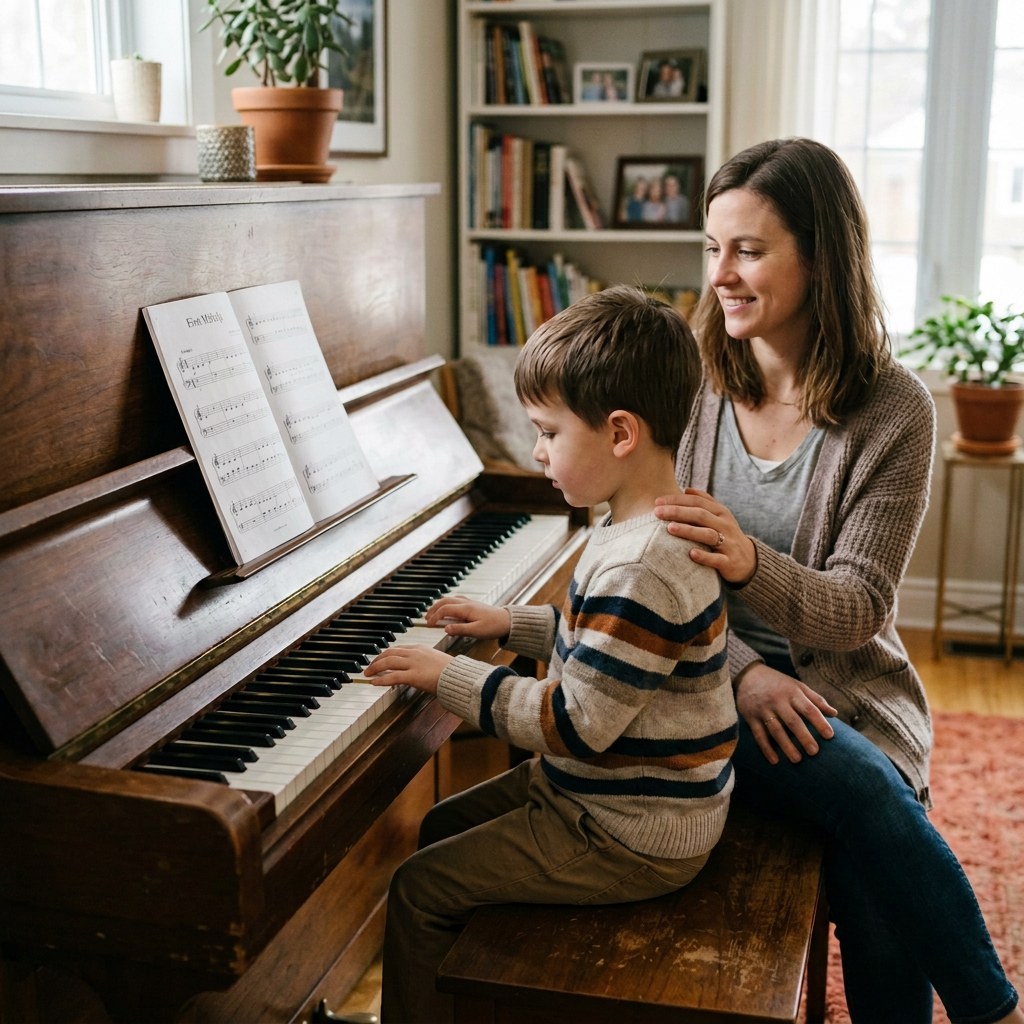
The first year of music lessons can be exciting, rewarding and occasionally confusing for parents. A child may learn a short piece quickly one week, then spend several lessons working through a difficult rhythm or hand position. That uneven pace is normal. Learning music involves several skills at once, including listening, reading, coordination, technique, memory and regular practice.
During the first year of music lessons, the most important changes are often foundational. Students learn how lessons work, how to practise between classes and how to respond when something does not come easily. They also begin building the musical vocabulary and physical habits that support everything they will learn later.
After nearly 90 years of teaching music, Ontario Conservatory of Music has seen that beginners make the strongest long-term progress when parents understand what early learning really looks like. The goal is not to rush from one piece to the next. It is to help the student develop skill, confidence and a routine they can continue.
The First Few Months: Learning How to Learn Music
The earliest lessons usually focus on simple but essential skills. Depending on the student’s age, instrument and program, these may include posture, instrument care, hand position, basic rhythm, listening, note recognition and following a teacher’s directions.
To an adult, these steps can appear small. However, a beginner may be coordinating both hands, reading new symbols, listening to pitch and keeping a steady beat at the same time. A short exercise can therefore represent meaningful progress.
During the first few months, parents may notice that their child can:
- identify basic musical symbols, notes or rhythms;
- follow a short sequence of instructions;
- play simple patterns or beginner pieces;
- correct some mistakes after hearing or seeing them;
- remember what to practise between lessons; and
- sit and concentrate for longer periods than they could at the beginning.
Not every student reaches these milestones at the same time. Age, previous exposure to music, practice consistency, attention span and the instrument itself all influence the pace. Parents should compare a student with their own starting point, not with another child.
What Progress Looks Like During Beginner Music Lessons
Parents often expect musical progress to sound like increasingly difficult songs. Repertoire is one sign, but it is not the only one. A student may make substantial progress in rhythm, reading or technique before that improvement becomes obvious in a finished performance.
Useful first-year progress markers include:
- starting a piece with less assistance;
- recognizing repeated patterns;
- keeping a steadier tempo;
- using more controlled posture, breathing or hand position;
- recovering after a mistake instead of stopping;
- reading unfamiliar music more confidently; and
- explaining what the teacher asked them to work on.
Progress also comes in bursts. A student may seem to plateau while a new concept is taking shape, then suddenly use it comfortably. Temporary frustration does not automatically mean the lessons are failing. It often means the student has reached material that requires a new level of attention.
For a broader look at the habits that support lasting improvement, parents can read What We Have Learned After Nearly 90 Years of Teaching Music.
Will Your Child Need an Instrument at Home?
Weekly lessons alone are not enough for a student to develop consistent skills. Beginners need access to an appropriate instrument between lessons so they can complete assignments and reinforce what the teacher introduces.
For piano students, this does not necessarily mean purchasing an acoustic piano immediately. A suitable digital piano or keyboard may be enough to begin, although parents should ask the teacher about requirements such as:
- Full-sized keys
- Weighted or touch-sensitive keys
- A sustain pedal
- A stable bench and proper playing height
- A music stand
- A quiet, well-lit practice area
The cheapest keyboard is not always suitable for structured lessons. Limited key ranges, miniature keys and keys without touch sensitivity can restrict what students are able to practise. Before purchasing or renting an instrument, families should ask the school or teacher what will support the program.
The same principle applies to guitar, violin and other instruments. Correct sizing, safe storage, basic maintenance and suitable accessories all affect the student’s ability to practise comfortably.
Practice Expectations in the First Year
Practice between lessons helps turn a teacher’s instructions into independent skill. However, more time is not always better. A short, focused session completed regularly usually provides more value than one long session immediately before the next lesson.
The appropriate amount of practice depends on the student’s age, level, instrument and assignment. For many young beginners, the first goal is simply to establish a repeatable routine. The teacher can recommend a realistic amount of time and explain what the student should accomplish during it.
A practical home routine may look like this:
- Choose a consistent time when the student is not rushed or overtired.
- Remove avoidable distractions and prepare the instrument and music.
- Review the teacher’s notes or assignment before beginning.
- Work on one small section at a time instead of repeatedly playing the whole piece.
- End by playing something familiar or enjoyable when possible.
Parents looking for age-based guidance can also review How Much Should Children Practice Piano? A Parent’s Guide.
How Parents Can Help Without Taking Over
A parent’s role is important, especially with younger beginners, but support works best when it does not become constant correction. Most parents do not need musical training to help. They can provide structure, encouragement and a suitable place to practise.
Helpful parent involvement includes:
- protecting a regular practice time;
- asking the student what the teacher assigned;
- noticing effort and improvement rather than only mistakes;
- helping the student divide a difficult task into smaller parts;
- communicating persistent concerns to the teacher; and
- allowing the teacher to guide technique and musical correction.
Instead of asking, “Did you practise?” parents can ask, “What are you working on today?” or “Which part is getting easier?” These questions focus attention on the learning process and give the child a chance to describe their progress.
When Parents Have Their Own Musical Experience
Parents who play an instrument naturally want to help their child succeed. Their experience can be valuable, particularly when establishing a practice routine, explaining basic musical ideas or showing enthusiasm for the child’s progress.
However, parents should be careful not to become a second teacher. The methods, terminology or technique they learned may differ from what the child’s current teacher is introducing. Even well-intended advice about fingering, posture, rhythm, interpretation or practice order can confuse a beginner when it conflicts with the teacher’s instructions.
This does not necessarily mean that either approach is wrong. Music can be taught through different methods, and the teacher may also be introducing skills in a deliberate sequence that is not immediately obvious at home.
Musically experienced parents can provide the most effective support by:
- Asking the child to explain what the teacher assigned
- Referring to the teacher’s written notes
- Helping the child follow the assigned practice routine
- Encouraging careful repetition without introducing new techniques
- Saving technical questions or disagreements for a conversation with the teacher
- Avoiding comparisons such as “That isn’t how I was taught”
If a parent believes an instruction differs from what they consider the “right way,” they should contact the teacher rather than correcting the child independently. The teacher may have a specific reason for recommending that particular skill or method. Consistent guidance allows the student to concentrate on learning instead of deciding which adult’s instructions to follow.
Motivation Will Change Throughout the Year
Beginners often start with strong enthusiasm. Once the novelty fades, regular practice can feel more like work. That change does not necessarily mean the student has chosen the wrong instrument or lost interest in music. It may simply mean they have moved from initial excitement into real skill-building.
Parents can help by keeping expectations steady and realistic. Praise should be specific: “Your rhythm stayed even,” “You worked through that difficult section,” or “You remembered what your teacher showed you.” Specific feedback helps students connect effort with progress.
Occasional reluctance is normal. A longer pattern of frustration, anxiety before lessons or complete disengagement deserves attention. In that case, the parent and teacher should discuss the assignment level, practice routine, schedule and whether the student feels comfortable asking for help.
For more guidance, see Why Students Quit Music Lessons (And How Parents Can Prevent It).
Recitals and Early Performance Opportunities
A recital or informal performance can become an important milestone during the first year of music lessons. It gives the student a clear goal and introduces the experience of preparing a piece for an audience. At OCOM, performance opportunities vary by program and may include winter concerts, community recitals, ensembles or competitions.
The first performance does not need to be flawless to be successful. Preparing carefully, walking to the instrument, beginning the piece and continuing after a small mistake are all accomplishments. Parents can support the experience by treating nervousness as normal and avoiding pressure to deliver a perfect performance.
Some beginners enjoy performing immediately, while others need more time. Teachers can help determine when a student is ready and select material that matches their current ability.
Families interested in OCOM’s curriculum and performance opportunities can explore the piano lesson program and other music programs.
What Parents Should Not Expect After One Year
A full year of consistent lessons can produce meaningful change, but a beginner is still a beginner. Parents should not expect every student to read fluently, practise independently, perform without nerves or move through material at the same speed.
It is also unrealistic to expect constant enthusiasm. Music education includes repetition, correction and challenging work. The more useful question is whether the student is gradually becoming more capable, responsible and comfortable with the learning process.
At the end of the first year, a productive review with the teacher might consider:
- Which musical and technical skills have improved?
- Has the student developed a workable practice routine?
- What does the student enjoy most?
- Which areas still require support?
- What goals are appropriate for the next year?
Building a Foundation for the Second Year
The first year establishes the habits that make future learning possible. Students who continue may begin working with more complex repertoire, theory concepts, examinations, ensemble playing or additional performance goals. The exact path will vary, but the foundation remains the same: qualified instruction, consistent practice and achievable next steps.
For families considering beginner music lessons in Toronto, North York, Scarborough, Mississauga, Brampton, Milton and other Ontario communities, it helps to choose a program that can support both the first lesson and the years that follow. A structured curriculum gives teachers, students and parents a clearer way to recognize progress over time.
Parents can review OCOM’s locations or use the Getting Started page to ask about the right program for a beginner.
Frequently Asked Questions
How quickly should a beginner make progress in music lessons?
Most beginners show small improvements within the first few months, but progress varies by age, instrument, practice consistency and readiness. Look for changes in rhythm, note recognition, concentration, technique and confidence, not only the number of completed songs. Progress often comes in bursts rather than at a perfectly steady pace.
How much should a beginner practise?
The teacher should recommend an amount based on the student’s age and program. For many young beginners, brief and consistent sessions are more effective than infrequent long sessions. The first priority is creating a routine the family can maintain and making sure the student understands what to work on.
What if my child does not want to practise?
Occasional resistance is normal, especially after the novelty of starting lessons fades. Keep the routine predictable, divide assignments into smaller tasks and recognize specific effort. If reluctance becomes persistent, speak with the teacher about the difficulty level, schedule, lesson fit and any obstacles the student is experiencing.
Should a student perform in a recital during the first year?
A recital can provide a useful goal, but readiness differs. Some students enjoy performing early, while others benefit from more preparation. The teacher can recommend an appropriate opportunity and piece. The purpose of a first performance is experience and growth, not perfection.
What should a student be able to do after one year of music lessons?
There is no universal checklist. Many students can play several beginner pieces, recognize basic musical symbols, follow a practice assignment and demonstrate improved rhythm or technique. The strongest sign is usually a combination of musical progress, greater independence and a more established learning routine.
A Realistic First Year Creates a Stronger Beginning
The first year of music lessons is not a race toward advanced repertoire. It is a year of learning how to listen, practise, respond to feedback and work through difficulty. Progress may be gradual and uneven, but those early habits matter.
Parents can provide the greatest support by protecting a consistent routine, noticing meaningful improvement and maintaining open communication with the teacher. With patient guidance and a structured program, a beginner can finish the year with more than a collection of songs. They can finish with a foundation for continued musical learning.
To learn more about beginner programs, explore OCOM’s music programs, find a nearby Ontario Conservatory of Music location or get started with a program consultation.