
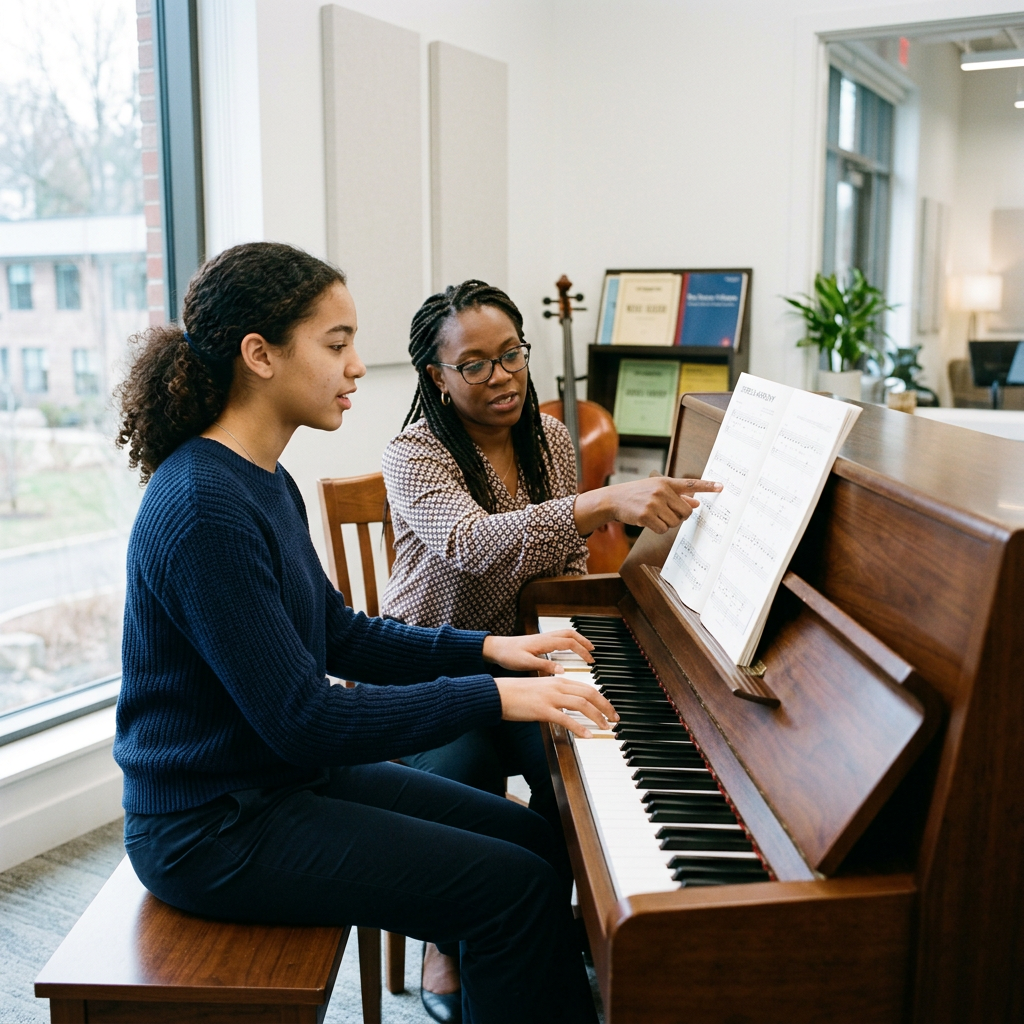
When most parents think about music lessons, they picture a student learning notes, practising songs, and gradually becoming more confident on an instrument. However, as students progress, learning how to play music is only part of their education. They also begin learning how music works.
Harmony in music is an important part of that understanding.
In simple terms, harmony describes what happens when different notes sound together and how those combinations relate to one another. It helps explain why certain chords sound settled, why others create tension, how music moves from one chord to the next, and why a melody can feel completely different when supported by different harmonies.
For developing musicians, studying harmony can change the way they hear, perform, analyze, and eventually create music. Instead of seeing a piece as a long sequence of individual notes, students begin recognizing the relationships and patterns underneath them.
That is why harmony forms an important part of a complete music education. It connects many of the skills students develop through instrumental study, theory, listening, performance, and more advanced musical study.
What Is Harmony in Music?
Harmony occurs when two or more notes sound together or when combinations of notes progress from one to another.
A melody, by comparison, is generally the musical line we recognize and might sing or hum. Harmony provides the musical structure around that melody.
Consider a familiar melody played by itself on the piano. It may be immediately recognizable. Now add chords underneath it. The notes of the melody have not changed, but the musical experience has.
Those chords can make the melody sound peaceful, dramatic, cheerful, uncertain, tense, or resolved.
As students study harmony, they begin to understand why.
Depending on their level, students may learn concepts such as:
- Intervals and relationships between notes
- Major and minor chords
- Chord construction
- Chord inversions
- Keys and scales
- Cadences
- Chord progressions
- Harmonic analysis
- How chords function within a key
Beginners do not need to understand all of these concepts at once. Harmony develops gradually as students acquire the musical knowledge needed to understand increasingly complex relationships.
How Is Harmony Different From Melody?
Melody and harmony work closely together, but they serve different musical functions.
Melody is the sequence of notes that forms a recognizable musical line. If you sing the main tune of a song, you are usually singing its melody.
Harmony describes the notes and chords that accompany or interact with that melody.
A useful way for parents to understand the difference is to imagine a student playing a simple tune with the right hand at the piano. That tune is the melody. When the student adds chords or other notes with the left hand, those notes contribute to the harmony.
However, harmony is much more than simply “the left-hand part.”
As music becomes more complex, harmony can appear throughout a composition and between several musical parts. Students playing in ensembles also experience harmony when their individual parts combine with those performed by other musicians.
Understanding this relationship helps students begin seeing a composition as a complete musical structure rather than simply the individual part they have been asked to play.
How Do Students Begin Learning Harmony?
Students usually encounter the foundations of harmony before they realize they are studying it.
A young piano student may learn to play a simple chord. A student may hear that one combination of notes sounds different from another. A teacher may ask whether a passage sounds major or minor.
These experiences begin developing harmonic awareness.
As students acquire stronger reading and theory skills, teachers can begin attaching names and concepts to what students already hear and play.
For example, a student might progress from simply playing a C major chord to understanding that it contains C, E, and G. Later, the student can learn why those notes form a major chord, how the chord can be rearranged through inversions, and how that chord functions in different musical contexts.
This gradual progression is important.
The objective is not simply to memorize terminology. Students should learn to connect what they study with the music they actually hear and perform.
Why Is Harmony Important for Developing Musicians?
Learning harmony helps students move beyond reproducing the notes printed on a page.
They begin to recognize the musical relationships behind those notes.
A beginning student may look at a measure and see eight separate notes that must be identified and played correctly. A more experienced student might immediately recognize that many of those notes belong to a familiar chord or harmonic pattern.
That recognition provides context.
Instead of processing every note as unrelated information, the student starts seeing larger musical structures.
This can influence several areas of musical development, including reading, listening, interpretation, memorization, ensemble playing, and advanced theory.
Over decades of teaching students, OCOM educators have seen the importance of connecting practical performance with broader musical understanding. Students still need to develop technique and practise their repertoire, but understanding the structure behind the music gives those practical skills a stronger foundation.
How Harmony Can Help Students Become Better Performers
A student can technically play every correct note without fully understanding the music.
Harmony helps provide that missing context.
Suppose a passage creates increasing harmonic tension before reaching a cadence. A student who recognizes what is happening can make more informed decisions about phrasing, dynamics, timing, and musical direction.
The student is no longer simply thinking:
Play these notes louder.
Instead, the student can begin understanding why the music is moving toward a particular point.
This distinction becomes increasingly important as repertoire becomes more advanced.
Harmony can also help students recognize patterns. Chords and harmonic progressions appear throughout music. Once students become familiar with those patterns, they may recognize musical structures rather than treating every new piece as completely unfamiliar material.
That can make learning increasingly sophisticated repertoire more manageable.
Harmony Develops More Active Listening
Music students need to learn to listen to more than themselves.
Harmony encourages that broader listening.
For a pianist, this might mean hearing the relationship between the melody and accompaniment rather than concentrating exclusively on each hand.
For students performing with other musicians, harmonic awareness becomes even more useful. Their own part may contain only a few notes, but those notes have a relationship with everything happening around them.
A student who understands harmony can begin asking:
- What role does my part play here?
- Which notes are most important?
- Is the music creating tension or resolving it?
- How does my part relate to what another musician is playing?
- Where is the music moving next?
Those are very different questions from simply asking, “Am I playing the right notes?”
Correct notes remain important. However, musical development eventually requires students to understand what those notes are doing.
Harmony Connects Performance and Music Theory
Students sometimes view theory and instrumental lessons as completely separate subjects.
Harmony demonstrates why they are connected.
Scales, intervals, key signatures, and chords are not arbitrary exercises created for theory worksheets. They describe structures students encounter constantly in actual music.
For example, learning a scale helps a student understand the notes associated with a particular key. Understanding intervals helps explain how chords are constructed. Understanding chords then helps the student recognize harmonic progressions.
Each concept supports the next.
This is one reason a structured approach to music education can be valuable. Instrumental technique, theory, harmony, listening, and performance do not need to exist as isolated subjects. As students progress, the connections between them become increasingly apparent.
OCOM’s curriculum includes theory and harmony alongside practical musical study because these areas help students develop a broader understanding of the music they perform.
Harmony Can Support Memory and Musical Independence
Recognizing musical structure can also give students another way to understand and remember repertoire.
Imagine trying to remember a random sequence of dozens of letters. Now imagine that some of those letters form familiar words and sentences.
The amount of information has not necessarily changed, but its organization has.
Music can work similarly.
A student who sees every note as an independent instruction has a great deal of information to process. A student who recognizes a chord, cadence, scale pattern, or familiar progression can group some of that information into meaningful structures.
Harmony therefore gives students another framework for understanding a piece.
As their knowledge develops, students may also become better equipped to investigate unfamiliar music independently. Rather than waiting for a teacher to explain every note or passage, they have tools that can help them determine what is happening.
The teacher remains an important guide, but the student gradually becomes a more independent musician.
Why Harmony Matters for Creativity and Composition
Harmony also becomes particularly valuable when students want to create music of their own.
A student can certainly experiment without formal harmonic knowledge. In fact, experimentation can be an excellent part of musical learning.
However, understanding harmony gives students additional tools.
They can explore questions such as why one chord progression produces a particular effect, how changing a chord alters a melody, or how a piece can move convincingly from one key to another.
Rather than restricting creativity, musical knowledge can expand the choices available to the student.
It is similar to learning vocabulary when writing. Knowing more words does not tell a writer what to say. It simply provides more ways to express an idea.
Harmony can serve a similar purpose for musicians.
How Harmony Prepares Students for Advanced Music Study
Harmony becomes increasingly important as students advance.
More sophisticated repertoire contains more complex harmonic relationships. Students may also encounter formal harmony requirements as they pursue higher levels of theory, examinations, composition, or other areas of musical study.
A student who has gradually developed harmonic understanding is better positioned to approach these concepts than one encountering them for the first time at an advanced level.
This does not mean young beginners need advanced harmony lessons.
Music education works best when concepts are introduced at an appropriate stage and then developed progressively. Students first establish basic musical skills. Teachers can then build on that foundation as the student’s abilities and understanding grow.
Eventually, harmony becomes another way for the student to answer one of the most valuable questions in music education:
Why does the music work this way?
Harmony Is Part of Understanding Music, Not Just Playing It
Learning an instrument requires considerable practical work. Students need to develop coordination, reading skills, technique, rhythm, listening skills, and familiarity with their instrument.
Those skills allow students to play music.
Harmony helps them understand more of what they are playing.
That distinction becomes increasingly important as students mature musically.
A complete music education should help students develop both practical ability and musical understanding. Theory and harmony provide students with tools for recognizing patterns, understanding relationships, interpreting compositions, and eventually approaching unfamiliar music with greater independence.
For parents, this can also help explain why music education sometimes includes activities that do not immediately look like instrumental practice.
Learning about chords, intervals, scales, or harmonic relationships is not separate from learning music.
It is part of learning the language behind it.
Frequently Asked Questions About Harmony in Music
Is harmony the same thing as music theory?
No. Harmony is one area within the broader study of music theory. Music theory can include notation, rhythm, scales, intervals, key signatures, form, harmony, and other concepts that explain how music is organized. Harmony focuses particularly on relationships between notes and chords and how those relationships function within music.
At what age should students start learning harmony?
There is no single age at which every student should begin formal harmony study. Students usually encounter basic harmonic concepts gradually as their practical and theoretical skills develop. Teachers can introduce simple chords and note relationships early, then build toward more formal harmony as students become ready for increasingly complex concepts.
Do beginners need to understand harmony?
Beginners do not need advanced harmonic knowledge to start learning an instrument. However, they can begin developing the foundations of harmonic understanding from their earliest lessons. Recognizing major and minor sounds, playing simple chords, learning scales, and understanding intervals can all contribute to skills they will use later.
Does understanding harmony help students play better?
Harmony can give students a deeper understanding of the music they perform. Recognizing chords, progressions, cadences, and other patterns can help students understand musical direction and structure. As students advance, that knowledge can inform interpretation, listening, memorization, and how they approach unfamiliar repertoire.
Why should students study harmony if they do not want to become professional musicians?
Harmony is not only for future professionals. It helps students understand the music they are learning, just as grammar and vocabulary help someone understand a language. A student can enjoy performing music without studying advanced harmony, but harmonic knowledge can provide a richer understanding of how that music is constructed.
Developing Musicians Who Understand What They Play
Harmony in music helps students discover the relationships beneath the notes they see on a page. As their understanding develops, chords become more than groups of notes, progressions become recognizable patterns, and musical passages begin to reveal their underlying structure.
That knowledge can support performance, listening, theory, creativity, and more advanced musical study.
Most importantly, studying harmony helps students make the transition from simply asking what notes do I play? to understanding why do these notes belong together?
Ontario Conservatory of Music takes a structured approach to music education that develops practical musicianship alongside theory, harmony, performance, and other areas of musical understanding. Families interested in learning more can explore OCOM’s music programs, find an Ontario location, or contact the school through the Getting Started page.