
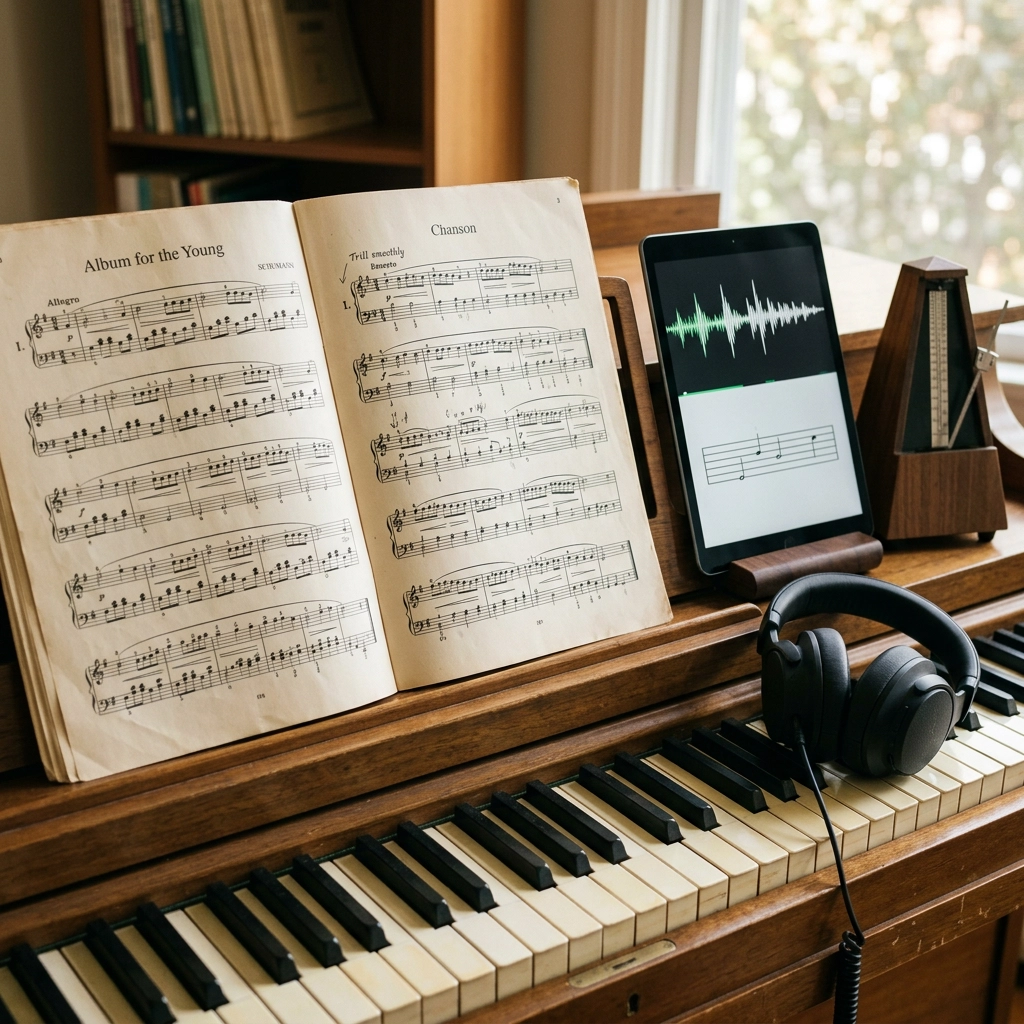
Children now have instant access to an extraordinary range of music. They can ask a smart speaker to play almost any song, watch an online tutorial, experiment with a music app, or generate a melody using artificial intelligence. Music has never been easier to find, share, or create.
However, access to music is not the same as learning music.
Music education in the digital age gives students something technology alone cannot provide: a structured process for turning curiosity into genuine ability. Students learn to listen carefully, practise with purpose, respond to feedback, solve musical problems, and gradually take ownership of their progress.
Technology can support that process. Digital metronomes, recording tools, notation software, and educational videos can all be useful. Yet these tools work best when they complement a strong curriculum and knowledgeable instruction.
After nearly 90 years of teaching students, Ontario Conservatory of Music has seen musical technology change many times. The instruments and learning tools may evolve, but the foundations of effective music education remain remarkably consistent: qualified instruction, regular practice, appropriate challenges, and meaningful human guidance.
Easy Access to Music Does Not Replace Music Education
A child can learn a surprising amount by watching videos or experimenting with an app. Online resources can introduce chords, demonstrate songs, and answer basic questions. For some students, they may even inspire an initial interest in playing an instrument.
The difficulty is that independent resources rarely provide a complete educational path.
A student may learn to imitate several songs without understanding rhythm, notation, technique, theory, or musical structure. They might also repeat an inefficient fingering or posture because no one has identified the problem. Over time, these gaps can make more advanced music increasingly difficult.
Structured music education helps students understand how individual skills fit together. Instead of moving randomly from one tutorial to another, they follow a logical progression that may include:
- Instrumental or vocal technique
- Music reading
- Rhythm and timing
- Ear training
- Theory and harmony
- Musical history and style
- Performance preparation
- Examination preparation, where appropriate
A qualified teacher can also adjust that progression to the student. If a concept is unclear, the teacher can explain it differently. If a piece is too easy or too difficult, the teacher can select more suitable material. An app may present information, but an experienced instructor can interpret what a particular student needs next.
Music Encourages Active Participation
Much of a child’s digital activity involves consuming something created by someone else. They watch, scroll, listen, react, or move quickly to the next piece of content.
Learning music requires a different kind of participation.
A student must physically produce the sound, listen to the result, recognize what needs improvement, and try again. Even when students use digital tools, they remain responsible for the performance. The metronome can mark the beat, but the student must follow it. A recording app can capture a passage, but the student must listen critically and decide what to change.
This distinction matters. Music lessons move students from being consumers of entertainment to active participants in a creative process.
Students also discover that meaningful progress does not always happen immediately. A difficult passage may require several days of focused work. Good tone, accurate rhythm, and expressive playing develop through repetition and correction. There is no button that can skip this part of the learning process.
That experience can help students develop a realistic understanding of how abilities grow: not through instant results, but through consistent effort over time.
Music Education Develops Focus in a Distracting Environment
Digital platforms often compete for attention through alerts, short videos, recommendations, and continuously changing content. Music practice creates an opportunity to work differently.
When students practise, they focus on a specific task. They may need to count a rhythm, coordinate both hands, listen for changes in pitch, or repeat a short section until it becomes consistent. This work rewards careful attention rather than rapid switching.
The goal is not necessarily to practise for hours. For many beginners, a short, focused session is more productive than a long session filled with distractions. What matters is that the student learns how to identify a goal and work toward it deliberately.
For example, instead of repeatedly playing an entire piece from beginning to end, a teacher might ask a student to:
- Identify the measure that is causing difficulty.
- Practise each hand or part separately.
- Reduce the tempo.
- Repeat the passage accurately.
- Reconnect it to the surrounding measures.
- Gradually return to the intended tempo.
This is a practical form of problem-solving. It shows students that improvement becomes more manageable when a large challenge is divided into smaller steps.
Parents can learn more about establishing an effective routine in our guide to how much children should practise piano.
Human Feedback Remains Essential
A digital tool can tell a student that a note was incorrect. A teacher can help the student understand why it was incorrect and what to do next.
Perhaps the student misread the key signature. Their hand position may make the passage harder than necessary. They may understand the notes but not the rhythm. In other cases, they may be playing accurately but without the phrasing or dynamics that give the music its character.
These situations require observation and judgment.
Teachers also recognize when a student needs encouragement, a clearer explanation, a smaller challenge, or additional responsibility. They can distinguish between a concept the student does not understand and one the student simply has not practised enough.
Furthermore, music involves interpretation. Two technically accurate performances can communicate very different ideas. An experienced teacher helps students consider phrasing, articulation, balance, tone, and historical context. These elements are difficult to reduce to a simple right-or-wrong response.
This is why technology is most useful as a teaching aid rather than a replacement for teaching. UNESCO has similarly emphasized that digital technology should complement, rather than replace, the human interaction at the centre of education.
Music Helps Students Understand the Technology They Use
Music education does not need to compete with technology. In many cases, it gives students the knowledge required to use musical technology more effectively.
Recording software, digital instruments, notation programs, and AI music tools can produce impressive results. However, students with a foundation in music are better prepared to evaluate those results.
They can ask useful questions:
- Is the rhythm accurate?
- Does the melody fit the harmony?
- Is the notation playable on the intended instrument?
- Does the arrangement suit the performer’s ability?
- Why does one version sound more convincing than another?
- Is the technology supporting the musical idea or distracting from it?
Without musical knowledge, a student may accept whatever a digital tool produces. With that knowledge, the student can make informed creative decisions.
The same principle applies to online tutorials. A student who understands notation, rhythm, theory, and technique can judge whether a tutorial is appropriate and connect it to previous learning. Musical literacy makes digital resources more useful because the student is no longer relying entirely on imitation.
Creativity Requires More Than Generating Content
Digital tools can now generate melodies, accompaniments, lyrics, and complete recordings within seconds. This has led some parents to wonder whether learning to play or compose music will remain worthwhile.
In many ways, music education has become more important because of these capabilities.
Generating content is not the same as developing an idea. Creativity involves making choices, recognizing relationships, revising work, and expressing something intentionally. Students need enough musical understanding to decide what they want to keep, change, or reject.
A student learning theory and harmony begins to understand why certain notes and chords work together. A student studying music history gains context for different periods, styles, and traditions. Instrumental study shows how musical ideas translate into an actual performance.
These areas of learning give students a vocabulary for creativity. Technology can expand the tools available to them, but education helps them use those tools with purpose.
Group Music Provides a Form of Connection Technology Cannot Fully Reproduce
Music can be created alone, but it is also a deeply collaborative activity. Playing in a group requires students to listen beyond their own part.
They must follow a shared tempo, respond to other performers, balance their volume, and recover when something unexpected happens. Each person contributes to the result, but no one has complete control over it.
These skills develop through direct participation. A recorded backing track can be useful for practice, but it does not adjust to the student. Another musician does.
Group instruction, bands, ensembles, and performance opportunities also give music a social purpose. Students are not simply completing an exercise for a teacher. They are contributing to something that other people can hear and experience.
For children who spend significant time communicating through screens, making music with teachers and fellow students can provide a valuable form of real-time cooperation.
Structured Learning Helps Students Navigate Unlimited Choice
The internet gives students access to more music than any previous generation could have imagined. That variety can inspire curiosity, but it can also make it difficult to know where to begin.
A student may jump between instruments, songs, apps, and tutorials without spending enough time on any one skill to make meaningful progress. When something becomes challenging, another option is always available.
A structured curriculum provides direction without eliminating personal interests. Teachers can include music a student enjoys while continuing to develop technique, reading, theory, and musicianship. This balance helps maintain enthusiasm without allowing short-term preferences to create long-term gaps.
Over nearly nine decades, OCOM has observed that successful students do not all share the same level of natural ability. However, they often benefit from several common factors:
- Clear and achievable goals
- Consistent attendance
- Regular practice
- Appropriate guidance
- Parent support
- Opportunities to recognize progress
- A curriculum that develops skills in a logical order
Technology may change the materials students use, but it does not remove the need for these foundations.
Finding the Right Balance Between Music and Technology
Parents do not need to choose between traditional music education and digital learning. A thoughtful program can use both.
Technology may help students:
- Practise with a metronome
- Record and review a performance
- Listen to professional interpretations
- Explore unfamiliar instruments
- Access accompaniment tracks
- Create and edit notation
- Communicate with a teacher when appropriate
However, technology should have a clear educational purpose. Adding more apps does not automatically improve learning.
Parents can ask a few simple questions when evaluating a tool:
- Does it support something the student is currently learning?
- Does it encourage active participation or passive watching?
- Does it provide accurate and age-appropriate information?
- Can the student explain what the tool is helping them practise?
- Has the teacher recommended or reviewed it?
The best digital resource is not necessarily the newest or most entertaining. It is the one that helps the student work toward a meaningful musical goal.
Why Music Education in the Digital Age Still Matters
Technology has transformed how children discover, hear, and create music. Used thoughtfully, it can make learning more accessible, interactive, and engaging.
Yet the abundance of digital tools has not made structured music education unnecessary. It has made guidance, musical understanding, and careful judgment even more valuable.
Music education in the digital age helps students move beyond pressing play. They learn how music works, how to perform it, how to interpret it, and how to create with intention. Along the way, they experience the value of sustained attention, constructive feedback, patient practice, and collaboration.
Ontario Conservatory of Music combines these enduring educational foundations with resources that support today’s students. Families can explore our music programs, review our Ontario locations, or visit the Getting Started section of our website to learn more about choosing an appropriate program.
Frequently Asked Questions
Can children learn music effectively from apps and online videos?
Apps and videos can be useful supplements, especially for listening, demonstrations, and practice support. However, they rarely provide the observation, correction, and personalized progression that a qualified teacher can offer. Students often make stronger progress when digital resources support a structured program rather than serve as the entire program.
Will AI make learning an instrument unnecessary?
AI can generate music, but it does not replace the experience of understanding and performing music. Learning an instrument allows students to interpret ideas, make creative decisions, respond to other musicians, and develop skills through practice. AI may become another musical tool, but students still need musical knowledge to use it thoughtfully.
Should students use tablets or phones while practising?
A device can help when it serves a specific purpose, such as running a metronome, playing an accompaniment, displaying approved music, or recording a performance. However, notifications and unrelated apps can interrupt concentration. When possible, families should limit the device to the task being practised.
Is traditional sheet music still relevant?
Yes. Reading notation gives students access to music without relying on a recording or tutorial. It also helps them understand rhythm, pitch, dynamics, articulation, and musical structure. Digital sheet music may change the format, but the underlying literacy remains valuable.
How can parents choose a music program in the digital age?
Look beyond the technology a school offers. Ask about teacher qualifications, curriculum, progress monitoring, theory instruction, practice expectations, and how lessons adapt to individual students. Technology can enhance a program, but clear educational goals and knowledgeable teaching should remain at its centre.