
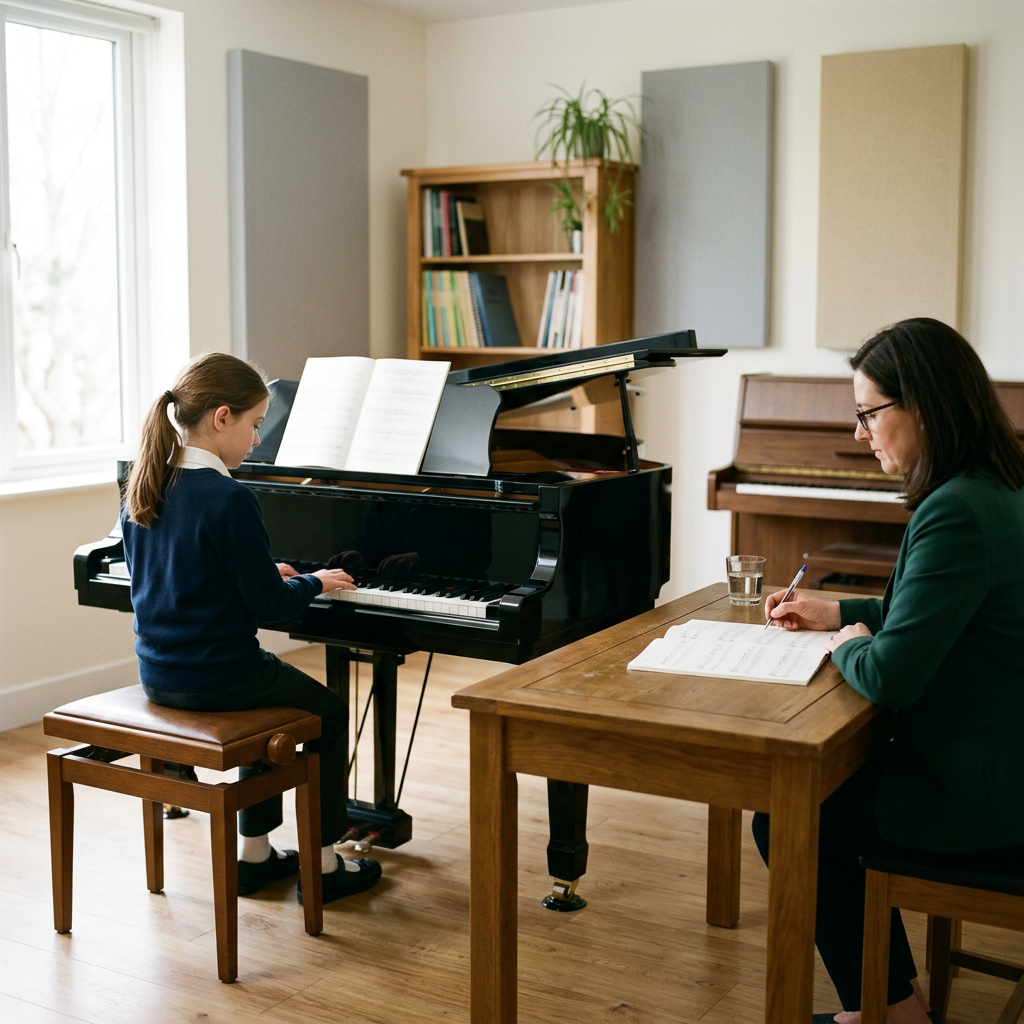
For many families, music exams are one of the least familiar parts of music education. Parents may wonder what happens during an exam, how a student knows when they are ready, whether examinations are required, and how much pressure the process will place on their child.
The good news is that a well-planned music examination should not feel like a sudden test. It is the result of steady preparation with a teacher who understands the student’s current ability, learning pace, and goals. The examination gives the student an opportunity to present prepared music, demonstrate technical and musicianship skills, and receive feedback from a qualified examiner.
Ontario families often encounter the examination system offered through The Royal Conservatory of Music (RCM). Its level-by-level structure provides a recognized framework for practical study and related subjects such as theory. However, an examination is not the purpose of every lesson. It is one milestone within a much longer musical education.
This guide explains how Royal Conservatory exams work, what students can gain from the experience, what parents should expect, and how families can support preparation without turning practice into a daily source of stress.
What Are Royal Conservatory Music Exams?
The Royal Conservatory Certificate Program organizes musical study into progressive levels. Requirements differ by instrument, voice, and level, so families and teachers should always consult the current syllabus for the student’s discipline.
A practical examination generally asks a student to demonstrate several areas of musicianship rather than simply perform one favourite song. Depending on the instrument and level, the exam may include:
- Prepared repertoire selected according to syllabus requirements
- Technical work, such as scales, chords, arpeggios, or other patterns
- Ear-training or aural skills
- Sight-reading or other reading skills
- Additional requirements specified for that instrument and level
Theory, harmony, history, and related written subjects form another part of the broader certificate program. At certain stages, students may need specific co-requisites to receive a comprehensive certificate. The teacher can explain which requirements apply and how practical and theoretical study fit together.
Royal Conservatory examinations provide an external assessment. The examiner is not replacing the student’s regular teacher. Instead, the examiner evaluates what the student presents on that day according to an established standard and provides a written examination form with marks and comments.
How the Royal Conservatory Exam Process Works
The exact process may change, and examination dates vary by session. Parents should use the current information on the Royal Conservatory examinations website when planning. In general, the process follows several clear steps.
- The Teacher Recommends a Level and Timeline
Exam preparation begins with an honest discussion between the teacher, student, and parent. The teacher considers more than whether the student can play the required pieces from beginning to end. Readiness also includes technical control, musicianship skills, consistency, concentration, and the time available to prepare.
Students do not all progress through levels at the same pace. One child may need additional time to develop secure reading or technique, while another may be ready sooner. A thoughtful timeline supports stronger learning than registering simply because a friend or sibling is taking an exam.
- The Student Prepares the Required Material
Once a goal has been established, the teacher helps select appropriate repertoire and organizes the remaining requirements. Preparation usually takes place over many months, not during a last-minute push.
Lessons may include focused work on:
- Accuracy, rhythm, tone, and musical expression
- Memory, where memorization is required or chosen
- Technical requirements
- Ear training and sight-reading
- Performing without stopping after a minor error
- Entering the room, presenting materials, and communicating with the examiner
The student should gradually become familiar with the complete examination sequence. A mock exam can help the experience feel predictable before the actual day.
- A Parent or Student Registers Online
RCM registration is completed through an online account. Families choose the examination, level, format, and available session or appointment according to current RCM options. In-person examination sessions have registration deadlines. Remote practical examinations may offer different scheduling arrangements.
Before registering, confirm the level and examination code with the teacher. Families should also review the current fees, policies, deadlines, identification requirements, accompaniment rules, and cancellation or transfer terms. The RCM examination resources for students include registration information and exam-day checklists.
- The Student Completes the Examination
On exam day, the student presents the required program and skills to an examiner. The examiner may redirect the student, request only part of a technical requirement, or continue to the next section once enough material has been heard. This is normal and does not necessarily indicate that something went wrong.
Parents usually do not participate in the examination itself. Their most useful role is to help the student arrive prepared, on time, and with the required music or documentation. Calm, practical support is more helpful than a final burst of coaching in the waiting area.
- Results and Feedback Become Available
According to the RCM’s current Certificate Program FAQs, practical examination results and the examination form are generally available online four to six weeks after the exam. Families should treat the report as feedback, not simply as a single number.
The teacher can help interpret the examiner’s comments, recognize progress, and identify the next areas for development. A lower-than-expected mark does not erase the work completed. Likewise, a strong mark is worth celebrating, but it does not mean the student has finished developing the skills from that level.
What Are the Benefits of Music Exams?
When the timing is appropriate, music exams can add focus and meaning to a student’s studies.
A Clear, Measurable Goal
An examination gives students a defined destination. Instead of practising only for the next lesson, they work toward completing a balanced program by a particular time. This can help students understand how daily effort connects to a longer-term result.
A Broad Musical Foundation
Because the examination includes more than repertoire, students must continue developing technique, reading, listening, and musical understanding. A student who plays polished pieces but avoids sight-reading, for example, cannot rely on repertoire alone.
Experience Performing Under Pressure
It is normal to feel nervous when playing for an unfamiliar examiner. With preparation, students learn that nervousness can be managed. They practise beginning without repeated attempts, continuing after small mistakes, and concentrating through the full program.
The goal is not to eliminate every nervous feeling. It is to help the student perform even when the experience feels important.
Independent Feedback and Recognition
An examiner provides an outside perspective based on a consistent set of requirements. The resulting report can confirm strengths and identify skills that need more attention. Certificates and completed levels also give students a tangible record of progress.
Preparation for Advanced Study
Students who continue into senior levels gain experience with increasingly demanding repertoire, theory, history, harmony, and formal performance expectations. This structured foundation may support future musical goals, including advanced study. Requirements for certificates, school recognition, or other pathways should always be checked against the current rules that apply to the individual student.
What Parents Should Realistically Expect
Exam preparation changes the rhythm of lessons. As the date approaches, a student may spend more time refining established material and less time exploring new pieces. Repetition is part of the process, but it should remain purposeful.
Parents can expect some uneven weeks. A piece that sounded secure may temporarily become less consistent as the teacher corrects technique or adds musical detail. Students may also become tired of repertoire they have studied for several months. These moments do not automatically mean that the examination plan is failing.
After decades of preparing students for musical milestones, OCOM educators have seen that the most successful exam experiences share a few qualities: the goal suits the student, preparation begins early, practice remains consistent, and adults keep the result in perspective.
Parents should not expect perfection. Even a well-prepared student may make an unexpected mistake on exam day. Examiners assess the complete performance, and one missed note does not define the entire examination.
How to Help a Child Prepare for Piano Exams and Other Music Exams
The parent’s role is important, but it differs from the teacher’s role. At home, parents can create the conditions for regular practice and encourage the student to follow the teacher’s instructions.
Support a Consistent Routine
Short, focused practice on most days is usually more productive than one long session immediately before a lesson. The appropriate duration depends on the student’s age, level, goals, and teacher’s recommendations.
Help the student choose a regular time and reduce avoidable distractions. A written practice plan can divide the work into manageable sections: repertoire, technique, sight-reading, and ear training.
Ask Useful Questions
Instead of asking only, “Did you practise?” try questions that encourage the student to think:
- What did your teacher ask you to focus on today?
- Which section improved during this practice?
- Is there anything you want to ask at your next lesson?
- Would you like me to listen to a complete run-through?
These questions show interest without requiring the parent to become a second instructor.
Arrange Practice Performances
Students need experience playing from beginning to end without restarting every time something feels imperfect. A performance for family members, a recorded run-through, a studio recital, or a mock exam can make the formal examination feel less unfamiliar.
However, run-throughs should not replace detailed practice. Students still need time to slow down, isolate difficult passages, and follow the specific strategies provided by their teacher.
Keep the Language Around Results Balanced
Praise preparation, persistence, and musical growth rather than promising a particular mark. Comments such as “You have worked carefully and you are ready to show what you know” place attention on controllable actions.
After the exam, allow the student to describe the experience before analyzing it. When the report arrives, review it with the teacher. Celebrate what went well and turn constructive comments into a practical next step.
Are Music Examinations Right for Every Student?
Not every student needs the same examination path. Some students respond well to clear levels and formal milestones. Others may need more time before an exam becomes a productive goal. A student may also study music for enjoyment, ensemble participation, composition, or personal expression without making examinations the immediate focus.
The key question is not whether exams are universally good or bad. It is whether a particular examination, at a particular time, supports the student’s education.
Parents should discuss the following with the teacher:
- Is the student secure in the skills from the current level?
- Does the student understand what the examination involves?
- Is there enough preparation time without creating an unhealthy rush?
- How does the exam connect with the student’s broader goals?
- What alternatives could provide a meaningful milestone if an exam is not appropriate now?
A structured curriculum can prepare students thoroughly while still allowing teachers to respond to individual needs.
Frequently Asked Questions About Music Exams
Does my child have to take a Royal Conservatory exam every year?
Exam timing should reflect readiness, not simply the calendar. Some students may complete a level within a year, while others benefit from more time. The amount of study required also changes as levels become more advanced. Parents should ask the teacher whether an examination is the right next milestone and whether the proposed timeline allows the student to prepare the complete set of requirements securely.
What happens during a piano exam?
The exact requirements depend on the level and current piano syllabus. A piano exam commonly includes prepared repertoire, technical requirements, ear tests, and sight-reading or other musicianship components. The examiner directs the sequence and records an assessment. Students should prepare from the current syllabus with their teacher rather than relying on a checklist from a previous edition or another student’s level.
What if my child makes a mistake during the exam?
Small mistakes are normal in live performance. Students should learn to continue whenever possible instead of stopping to apologize or repeatedly starting again. An examiner considers the overall presentation across multiple areas. Preparation should therefore include complete run-throughs so the student becomes comfortable recovering from a missed note, memory slip, or moment of uncertainty.
Can Royal Conservatory exams be taken remotely?
The RCM currently offers remote practical examinations as an alternative to traditional in-person exams. Technical, room, instrument, accompaniment, and camera requirements vary by discipline and level. Families considering this format should review the current remote practical exam information and discuss whether the format suits the student with their teacher.
How should we respond if the mark is lower than expected?
Begin by recognizing the work required to complete the examination. Then review the examiner’s full report with the teacher. A mark reflects one assessment on one day; the comments often provide more useful direction for future study. The teacher can distinguish between an isolated exam-day issue and a skill that needs further development, then create a clear plan for the next stage.
Music Exams as Part of a Longer Education
Well-prepared music exams can give students a clear goal, a broad technical and musical foundation, independent feedback, and a meaningful sense of achievement. They work best when families see them as milestones rather than races or final judgments.
Ontario Conservatory of Music has helped generations of students prepare for examinations within a structured program that also includes performance, theory, and ongoing musical development. Families can explore OCOM’s music programs, review piano lesson options, find a nearby Ontario location, or visit the Getting Started page to discuss a student’s goals and readiness.