
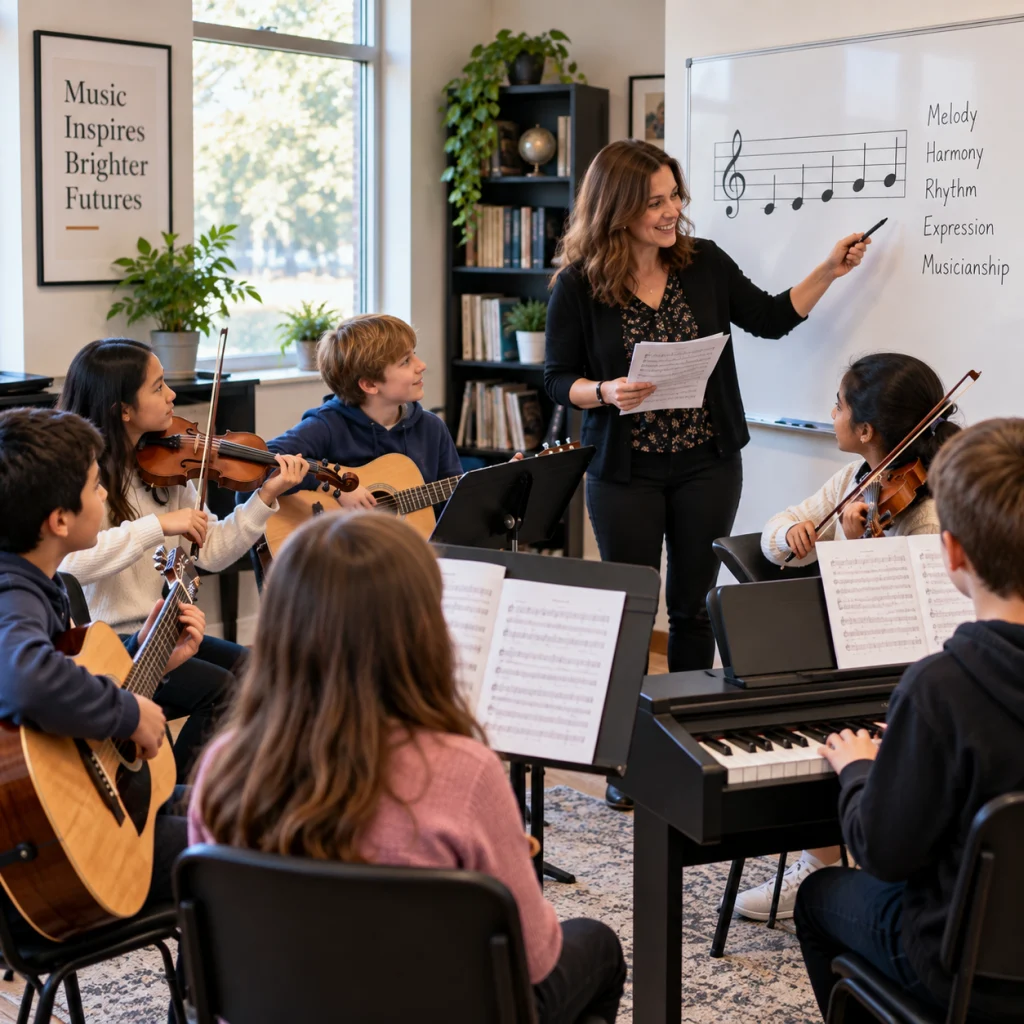
For many parents, “music lessons” and “music education” may sound like two ways of describing the same thing. A child attends a weekly piano, guitar, violin, vocal, or other instrumental lesson, learns new material, practises at home, and gradually becomes a better musician.
But there is an important difference.
A music lesson is an individual part of the learning process. Music education is the larger structure that connects those lessons and develops a student’s musical knowledge over time.
At Ontario Conservatory of Music (OCOM), that distinction has been part of our approach since 1939. Over nearly nine decades, the way students learn has changed considerably. Teachers and students now have access to digital resources, online tools, new teaching methods, and technology that musicians in 1939 could hardly have imagined.
Yet many of the fundamentals of a strong music education have remained remarkably consistent.
Understanding that difference can help parents look beyond the weekly lesson and consider what their child is actually learning — and where that learning may eventually take them.
What Is the Difference Between Music Lessons and Music Education?
A music lesson usually focuses on what a student needs to learn at a particular stage. Depending on the instrument, level, and student, a lesson might include:- Learning a new piece of music
- Improving technique
- Correcting fingering, posture, rhythm, or articulation
- Reviewing material from the previous week
- Preparing for an examination or performance
- Introducing a new musical concept
- Identifying areas to practise before the next lesson
A Music Lesson Is an Event. Music Education Is a Process.
One of the easiest ways to understand the distinction is to think about time. A lesson might last 30, 45, or 60 minutes. Music education can continue for years. Each lesson builds upon previous learning. A beginner may start by learning basic notes, rhythms, and technique. Those fundamentals then support increasingly complex music. Over time, students begin making connections. Why does a particular chord sound the way it does? Why does a composer use a certain rhythm? How is a piece structured? Why does one interpretation sound different from another? Those questions move beyond simply playing the correct notes. This is one reason a structured curriculum can be valuable. It gives teachers and students a framework for progressing from fundamental concepts toward more advanced musicianship. The individual lesson remains important, but it becomes one part of something larger.What Does a Complete Music Education Include?
Music education can take different forms depending on the student’s age, instrument, goals, and level. There is no single path that every student must follow. However, a well-rounded program may introduce several interconnected areas of learning.Practical Instruction
This is what most people picture when they think about music lessons. Students develop technique and learn repertoire appropriate to their current ability. Teachers can identify problems, demonstrate techniques, introduce new material, and help students develop effective practice habits.Music Theory
Theory helps explain how music works. Students learn concepts such as notation, scales, intervals, rhythm, key signatures, chords, and musical structure. For a young beginner, theory may start with very simple concepts. As students advance, that knowledge becomes increasingly useful for understanding the music they perform.Harmony
Harmony explores how notes and chords work together. As students progress, studying harmony can help them understand relationships within music rather than viewing a composition simply as a sequence of individual notes.Music History
Music did not develop in isolation. Learning about composers, musical periods, styles, and historical context can help students understand why music was written in a particular way and how musical ideas developed over time.Examinations and Performance
For students following an examination pathway, preparation provides measurable goals and a structured progression through different levels. Performance opportunities can provide another type of learning experience. Preparing music for an audience requires students to bring together many of the skills they have developed during lessons and practice. Not every student will follow exactly the same route. However, these elements demonstrate why music education can extend considerably beyond learning an instrument.How Music Education Has Changed Since 1939
When Ontario Conservatory of Music began teaching students in 1939, the musical world looked very different. There were no smartphones, tablets, streaming services, YouTube tutorials, digital sheet music libraries, or video lessons. Recorded music itself was far less accessible than it is today. Students primarily learned through their teachers, printed music, books, recordings, performances, and their own practice. Today, a student can hear thousands of performances of a piece within seconds. That access has created extraordinary educational possibilities. Students can listen to orchestras around the world, compare interpretations by different musicians, access digital practice tools, study scores online, and hear music from cultures and traditions they might never otherwise encounter. Teachers have new resources as well. However, greater access to information has not eliminated the need for education. In some ways, it has made guidance even more valuable. We explored this idea in more detail in Why Music Education Is More Relevant Than Ever in the Digital Age.Information Is Easier to Find. Understanding Still Takes Time.
A student today can search for almost any musical question online. “How do I play this chord?” “What notes are in this scale?” “How should this passage sound?” A video or website may provide an immediate answer. But knowing an answer and understanding a concept are different things. A teacher can see how a student applies information. They can identify whether a technique is being performed correctly, explain why something works, connect a new concept to previous learning, and adjust instruction to the individual student. That interaction is difficult to replace with information alone. Technology has therefore become another useful educational resource rather than a substitute for the learning process.Some Fundamentals Have Not Changed
Nearly 90 years of teaching provides an interesting perspective on educational trends. Teaching tools change. Musical tastes change. Technology changes. The ways students access music change. Yet many characteristics of successful music students remain familiar. Students still benefit from regular practice. They still need time to develop physical and musical skills. They still encounter difficult passages that require patience and repetition. They still progress from simpler concepts toward more complex ones. And they still benefit from teachers who can recognize what they understand, identify what they are struggling with, and determine what they should learn next. There may be new ways to support those fundamentals, but technology has not made the fundamentals disappear. Many of these same patterns are explored in What We Have Learned After Nearly 90 Years of Teaching Music.Music Education Can Adapt to Different Goals
Not every student begins music lessons for the same reason. Some children simply want to learn songs they enjoy. Others may become interested in examinations, performance, composition, or more advanced study. Some students will study music for a few years. Others may continue throughout their lives. A structured music education does not mean every student must have exactly the same destination. Instead, structure provides a foundation from which different paths can develop. A student interested primarily in playing contemporary music still benefits from rhythm, technique, notation, and musical understanding. A student pursuing examinations requires those fundamentals as well, although the goals and progression may differ. Good music education provides direction without losing sight of the individual student.What Should Parents Look for in Music Education?
Parents do not need to be musicians themselves to ask useful questions about their child’s education. When considering a music program, it can help to ask:- Is there a structured progression? What will students learn as they move from beginner to intermediate and advanced levels?
- What qualifications do the teachers have? Musical ability and the ability to teach music are both important.
- Does the program teach more than repertoire? Consider how theory, musicianship, technique, and other areas are incorporated.
- Can the program accommodate changing goals? A child’s interests at age seven may be very different at age twelve.
- Is progress being evaluated? Teachers should be able to explain what a student is learning, where improvement is occurring, and what comes next.