
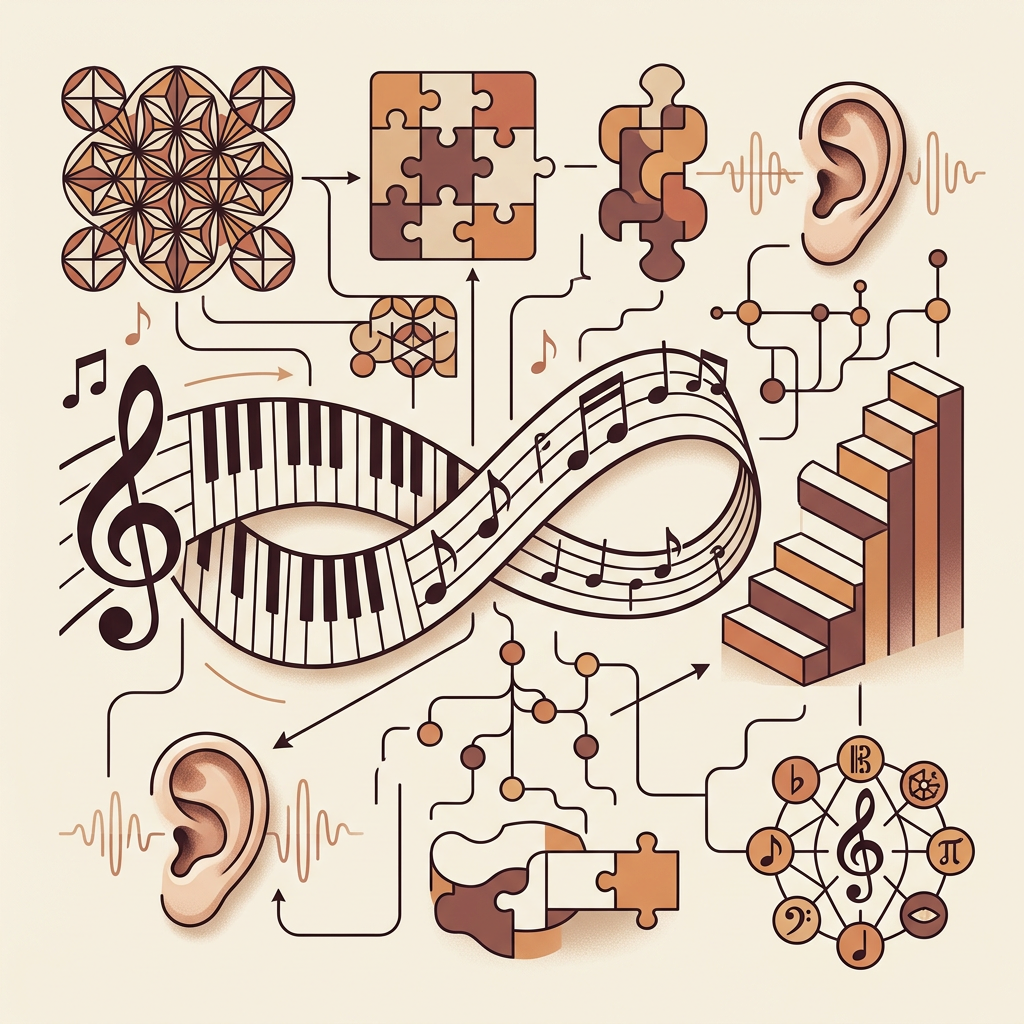
Parents often enrol their children in music lessons because they want them to learn an instrument. A child may be excited about playing the piano, violin, guitar, or another instrument, while parents may simply hope that music becomes an enjoyable and rewarding part of their education.
But learning an instrument involves much more than learning which notes to play.
Music education encourages children to think, listen, analyze, make decisions, recognize patterns, solve problems, and respond to feedback. These skills are used repeatedly as students progress from their first lessons to more advanced music.
The long-term benefits of learning music as a child therefore aren’t limited to musical ability. The process itself provides regular opportunities to practise many of the thinking and learning skills children use throughout their education.
At Ontario Conservatory of Music (OCOM), nearly 90 years of teaching have also shown us something important: meaningful progress in music rarely comes from one lesson, one examination, or one successful performance. It develops gradually through consistent learning, increasing challenges, and the opportunity to apply skills in new ways.
Why Learning Music Requires More Than Memorization
A beginner may initially appear to be memorizing information: the names of notes, finger positions, rhythms, scales, or musical terminology.
However, students soon need to do something more important with that information.
They need to apply it.
Consider what happens when a student encounters a difficult section of music. Simply knowing the notes may not solve the problem. The student may need to determine:
- Which part of the passage is causing difficulty?
- Is the problem the notes, rhythm, fingering, or technique?
- Is the student playing too quickly?
- Is there a pattern that makes the passage easier to understand?
- What could the student change to improve the result?
Instead of simply being told that something is wrong, students can learn to identify the problem and consider possible solutions.
That is one reason structured music education can provide so many opportunities to practise critical thinking.
How Music Education Encourages Critical Thinking
Critical thinking doesn’t necessarily mean solving complicated academic problems. For children, it often begins with learning to examine information, recognize relationships, make decisions, and evaluate results.
Music provides opportunities to do all of these things.
Recognizing Patterns
Music is filled with patterns.
Students encounter repeating rhythms, scales, chords, intervals, melodic sequences, and familiar musical structures. As their knowledge develops, they begin to recognize these patterns rather than seeing every note as an unrelated piece of information.
A beginner might see eight individual notes.
A more experienced student might recognize those same notes as part of a scale, chord, or musical phrase.
Pattern recognition helps students organize what they are seeing and hearing. It can also make unfamiliar music easier to understand.
Identifying Problems
Practice doesn’t always go according to plan.
A passage may repeatedly sound wrong. A rhythm may feel awkward. Two measures may consistently cause the student to stop.
An important part of learning is figuring out why.
A teacher can help students move from simply saying, “I can’t play this,” toward asking more useful questions:
Where exactly am I having difficulty?
What is causing the problem?
What can I try differently?
That process encourages students to break a larger challenge into smaller, more manageable parts.
Testing Solutions
Once students identify a problem, they can try different approaches.
They might slow the music down, practise each hand separately, isolate two difficult measures, count the rhythm aloud, change their fingering, or repeat a short passage several times.
Then they listen to what happens.
Did the change help?
If not, what should they try next?
This creates a simple but valuable cycle:
Identify the problem → try a solution → evaluate the result → adjust.
Students may repeat that process hundreds of times as they learn an instrument.
Learning to Listen Critically
Playing music requires more than producing sound. Students also need to listen to what they are producing.
Young beginners may initially focus so intensely on finding the correct notes that they don’t notice everything they hear. With experience, however, students can begin paying attention to rhythm, dynamics, articulation, tone, balance, phrasing, and expression.
They gradually learn to compare what they intended to play with what they actually played.
That distinction matters.
A student who recognizes an error independently has taken an important step beyond waiting for a teacher to identify it. The student is beginning to evaluate their own performance.
Teachers remain important throughout this process, but one of the goals of quality instruction is to help students become increasingly capable of listening, thinking, and making informed musical decisions themselves.
Theory Helps Students Understand Why Music Works
This is also where music theory becomes particularly valuable.
Students can learn to reproduce music without fully understanding its structure. However, theory helps explain the relationships behind what they are playing.
Scales, intervals, chords, key signatures, rhythm, and harmony give students a framework for understanding music.
Instead of seeing a page filled with unrelated symbols, students can begin recognizing how those elements work together.
At OCOM, theory and harmony are part of a broader approach to music education. The objective isn’t simply to add more material to a student’s workload. These subjects can deepen a student’s understanding of the music they perform.
That understanding becomes increasingly useful as the music becomes more complex.
The Role of the Teacher Changes as Students Progress
When children first begin music lessons, they naturally depend heavily on their teacher.
The teacher explains what to do, demonstrates techniques, corrects mistakes, and provides clear instructions for practice.
Over time, that relationship can evolve.
Rather than immediately supplying every answer, an experienced teacher may ask questions:
What did you notice there?
Why do you think that happened?
Where does the phrase begin and end?
What could you do differently?
The purpose isn’t to make learning unnecessarily difficult. It is to encourage the student to participate actively in solving musical problems.
Gradually, students can take greater responsibility for their own learning.
Why Long-Term Music Education Matters
Many of the benefits associated with learning music don’t appear overnight.
A few lessons can introduce a child to an instrument. Developing musical understanding, however, takes time.
As students progress, the challenges change.
A beginner may concentrate on reading notes and maintaining a steady rhythm. Later, the same student may be working on more complicated technique, interpreting musical phrases, understanding harmony, preparing for an examination, or making decisions about how a piece should be performed.
In other words, the problems become more sophisticated as the student becomes more capable of solving them.
This progression is one of the important long-term benefits of learning music as a child.
Students aren’t simply repeating the same activity year after year. Ideally, they are continually building upon what they already know.
Persistence Is Part of the Learning Process
Music also teaches students something very practical: improvement often requires repeated effort.
Some pieces come easily. Others don’t.
Students may spend days or weeks working on a difficult passage before it becomes comfortable. They may prepare extensively for an examination or performance. Sometimes progress happens quickly; sometimes it happens in very small increments.
There is no guarantee that every child will respond to these challenges in exactly the same way.
However, structured music education gives students repeated opportunities to experience the relationship between focused practice and gradual improvement.
They can learn that difficulty does not necessarily mean they are incapable of doing something. Sometimes it simply means they have not learned how to do it yet.
Students Learn to Work Toward Longer-Term Goals
Children naturally tend to focus on what is happening right now.
Music education introduces goals that may take weeks, months, or even years to achieve.
A student might work toward:
- Learning a complete piece of music
- Performing at a recital
- Completing a particular level
- Preparing for a music examination
- Developing a difficult technical skill
- Understanding increasingly advanced theory or harmony
These larger objectives need to be broken into smaller steps.
A recital isn’t prepared the night before. An examination level isn’t completed in one lesson. Students progress through regular lessons and practice, gradually building toward the larger objective.
That experience can help children become more familiar with planning, preparation, and delayed results.
Confidence Can Grow From Competence
Confidence is often discussed as a benefit of music lessons, but it is important not to treat confidence as something that automatically appears simply because a child takes lessons.
A more useful way to think about it is through competence.
A student encounters something difficult.
They work on it.
Eventually, something that once seemed impossible becomes manageable.
That experience can be meaningful.
Whether it is performing a complete piece, passing an examination, mastering a difficult passage, or simply realizing that today’s music would have seemed impossible a year earlier, students can see tangible evidence of their own progress.
Over years of teaching, OCOM instructors have seen how important these incremental accomplishments can be to long-term musical development.
Why Structured Music Education Makes a Difference
There is an important distinction between occasionally playing an instrument and receiving a structured music education.
Both can be enjoyable, but they serve different purposes.
A structured program provides progression. New knowledge builds on previous knowledge, and students encounter increasingly sophisticated material as their abilities develop.
That may include:
- Instrumental instruction
- Music theory
- Harmony
- Music history
- Examination preparation
- Performance opportunities
- Group learning experiences
These components help students understand music from different perspectives.
For families considering music lessons, it can therefore be helpful to look beyond the instrument itself and ask how the overall program supports a child’s development as a musician.
What Nearly 90 Years of Music Education Has Taught Us
Ontario Conservatory of Music has been teaching students since 1939.
Across generations, teaching methods, technology, popular music, and family schedules have changed considerably. However, some aspects of learning music have remained remarkably consistent.
Students need appropriate challenges.
They need knowledgeable teachers.
They need opportunities to practise and apply what they learn.
And they need time.
Long-term progress rarely follows a perfectly straight line. Students sometimes advance quickly and sometimes struggle. Interests can change. Motivation can fluctuate. Different children respond to different teaching approaches.
That is why experienced instruction matters.
Quality music education isn’t about forcing every child through an identical process. It provides structure while allowing teachers to respond to the individual student in front of them.
OCOM’s experience is explored further in What We Have Learned After Nearly 90 Years of Teaching Music.
Families interested in OCOM’s approach can learn more about getting started with music lessons and the programs available throughout the Greater Toronto Area.
The Long-Term Benefits Go Beyond Playing an Instrument
A child who studies music for several years will hopefully become a more capable musician.
But that isn’t the only meaningful outcome.
During those years, the student has also spent considerable time reading unfamiliar information, recognizing patterns, solving problems, accepting feedback, correcting mistakes, preparing for goals, evaluating results, and trying again.
Music provides a setting in which these behaviours are practised naturally because they are necessary for learning.
Not every child will become a professional musician—and that isn’t the purpose of music education for most families.
The lasting value may simply be that a child learns how rewarding it can be to understand something deeply, work through difficulty, and gradually become capable of doing something they once could not do.
Frequently Asked Questions
Does learning music improve a child’s critical thinking skills?
Music education provides many opportunities to practise behaviours associated with critical thinking. Students identify patterns, analyze problems, test solutions, listen to results, and make decisions about their performance. It is more accurate to say that music provides opportunities to practise these skills than to claim that taking music lessons automatically makes a child a better critical thinker.
How long does a child need to take music lessons to benefit?
There is no single amount of time that applies to every student. Children progress at different rates and have different goals. However, many aspects of music education build progressively. Longer-term study allows students to move beyond basic skills and encounter increasingly sophisticated musical concepts and challenges.
Is music theory important for children learning an instrument?
Theory can help students understand the music they are playing rather than simply reproducing notes. As students progress, concepts such as scales, intervals, chords, rhythm, key signatures, and harmony can help them recognize relationships and understand musical structure.
What are the long-term benefits of learning music as a child?
Long-term music education can develop musical knowledge and instrumental ability while providing repeated opportunities to practise problem-solving, preparation, focused practice, self-evaluation, and working toward longer-term goals. The experience will be different for every child, so these should be viewed as learning opportunities rather than guaranteed outcomes.
Does my child need to become an advanced musician for music lessons to be worthwhile?
No. Professional performance is not the objective for most students. Music education can provide children with musical knowledge, practical skills, an appreciation for music, and the experience of steadily developing an ability over time. Those experiences can have value regardless of how far a student ultimately chooses to pursue music.
Building Skills That Can Last
The long-term benefits of learning music as a child begin with music itself: learning to play, read, understand, listen to, and appreciate it.
But the process asks children to do much more.
They encounter problems and search for solutions. They learn from mistakes. They recognize patterns. They work toward goals. They receive feedback and apply it. As their musical ability grows, they become capable of making increasingly sophisticated decisions for themselves.
Those skills don’t develop because music provides a shortcut to child development. They develop because learning music well requires students to think and participate actively in their own education.
For families considering music education, that may be one of the most valuable reasons to think beyond the first few lessons and consider what years of structured learning can offer. Families ready to explore lessons can learn more about getting started at Ontario Conservatory of Music.