
Learning to play an instrument and learning music are not quite the same thing.
A student can learn where to place their fingers, how to read notes on a page and how to perform a piece from beginning to end. Those are important skills. However, a well-rounded music education goes further. It helps students understand what they are playing, how music is constructed, how different musical ideas relate to one another and how music has developed over time.
For parents, that distinction can be easy to overlook. When choosing music lessons, the most obvious questions tend to be about the instrument, the teacher, lesson length and practice. Yet the education surrounding those lessons can have an equally important influence on a student’s long-term musical development.
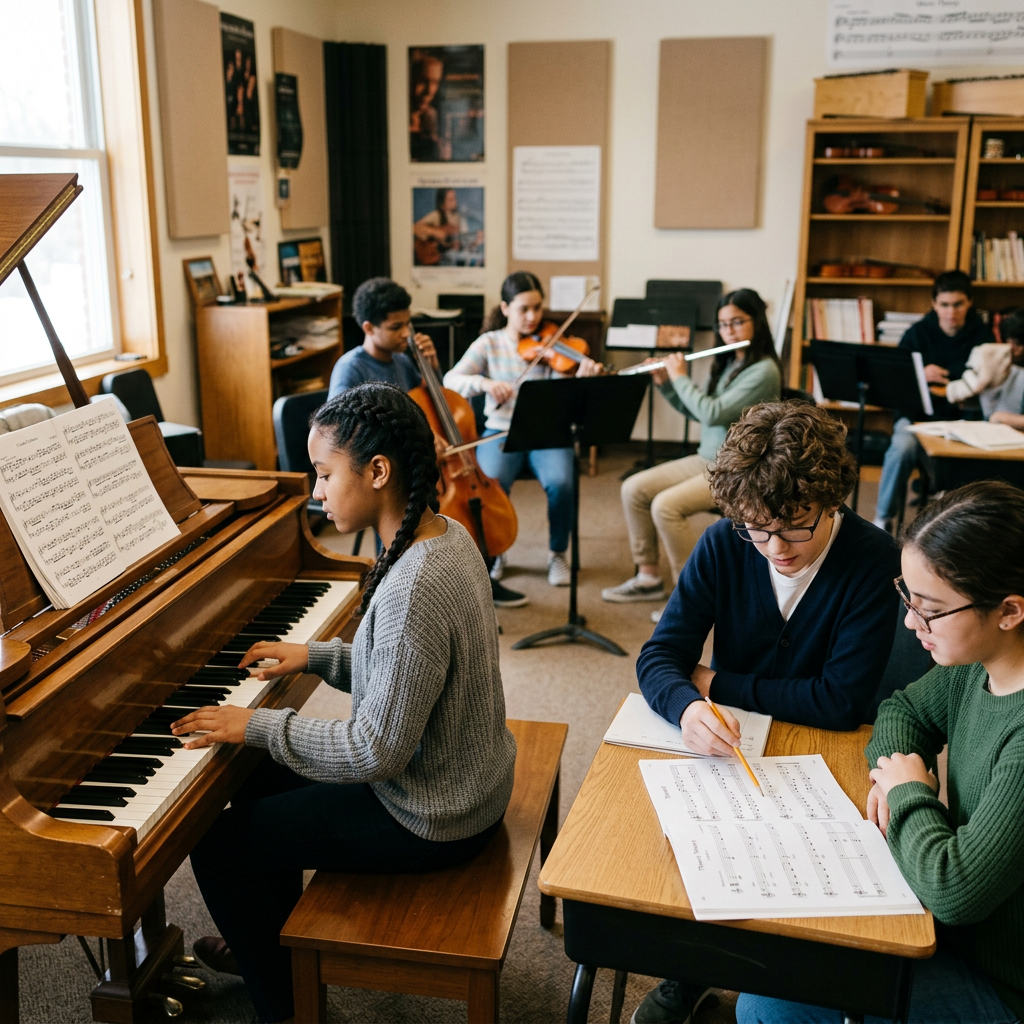
A complete music education can include instrumental or vocal instruction, music theory, harmony, history, performance, examinations and opportunities to make music with others. Each develops something different. Together, they help students become more knowledgeable, independent and versatile musicians.
Instrumental or Vocal Instruction Builds the Foundation
For most students, music education begins with an instrument or the voice. Lessons provide the practical foundation students need to make music. Depending on the instrument and the student’s level, instruction may include:- Proper technique
- Reading musical notation
- Rhythm and timing
- Listening skills
- Tone and expression
- Coordination
- Practice habits
- Repertoire development
Music Theory Helps Students Understand What They Play
Music theory gives students a framework for understanding the music they encounter. A beginning student may initially see a page of music as a collection of notes, rests and symbols. As their knowledge develops, they begin to recognize relationships and patterns. They learn about concepts such as scales, intervals, key signatures, rhythm, notation and musical structure. Instead of simply being told what to play, students can begin to understand what is happening within the music. That distinction becomes increasingly valuable as students advance. Consider the difference between memorizing a series of instructions and understanding the principles behind them. Both approaches may produce the correct result initially. However, understanding makes it easier to apply that knowledge to something new. Music works much the same way. A student who understands theory can begin recognizing familiar musical ideas in unfamiliar pieces. Theory provides a common language that connects much of what students encounter in their lessons.Harmony Explains How Music Fits Together
As students develop their theoretical knowledge, harmony takes that understanding further. Harmony explores how notes sound together and how chords and chord progressions create musical structure. It helps students understand relationships they may already have heard many times without knowing why they sound the way they do. For example, students may learn to recognize how a chord creates tension or how another provides a sense of resolution. They begin to see that the notes in a composition are not simply a sequence of independent choices. They relate to one another. This knowledge can support performance because students have a better understanding of the structure beneath the music. It can also become important for students interested in composition, arranging or more advanced musical study. Theory teaches students many of music’s building blocks. Harmony helps them understand how those blocks work together.Music History Gives Music Context
Music did not develop in isolation. The instruments we play, the notation we read, the forms composers use and even our expectations about how music should sound have evolved over hundreds of years. Music history helps students place what they are learning within that larger story. Rather than encountering composers simply as names printed at the top of a page, students can learn about the periods in which those composers lived, the musical traditions that influenced them and the ways musical styles changed from one era to another. That context can make repertoire more meaningful. Understanding something about the Baroque, Classical or Romantic periods, for example, can help a student recognize why pieces from those eras may sound and feel different. Historical knowledge can also introduce students to musical traditions and ideas beyond the repertoire they encounter during individual lessons. Students don’t need to become music historians to benefit from this knowledge. The goal is perspective. Knowing something about where music came from can help students better understand the music they are learning today.Performance Turns Learning Into Experience
Lessons and practice give students an opportunity to develop skills. Performance asks them to put those skills together. Preparing for a recital or another performance creates a different type of goal from preparing for the next weekly lesson. Students must work toward performing an entire piece rather than simply mastering the next section. That process can teach important lessons about preparation. Students learn that successful performances usually result from consistent work over time. They experience the difference between knowing a piece during practice and being ready to perform it for someone else. Performance also gives music a purpose beyond the lesson room. Music is ultimately meant to be heard and shared. Recitals and other performance opportunities allow students to experience that side of being a musician. Not every student will become a professional performer, nor does every student need to. Performance can simply be another part of learning to communicate through music.Examinations Can Provide Structure and Musical Milestones
Formal music examinations can provide students with clearly defined goals as they progress. An examination gives students something specific to prepare for and a milestone that recognizes the work required to reach a particular level. Preparation can bring together several areas of music education rather than focusing solely on repertoire. Depending on the examination and level, students may need to demonstrate technical skills, musical knowledge and performance ability. This makes examination preparation useful as part of a structured educational path. Examinations are not simply about receiving a mark. The preparation itself can be valuable. Students work toward a defined standard, learn to prepare material carefully and gain experience demonstrating what they have learned. For parents, formal milestones can also provide a clearer picture of progression over a longer period of study.Playing With Others Develops Different Musical Skills
Private instruction is valuable because it allows a teacher to focus closely on the needs of one student. However, making music with other people introduces skills that are difficult to develop when a student always plays alone. In an ensemble, band, combo or other group setting, students must listen to more than themselves. They need to hear what other musicians are doing while maintaining their own part. They may need to adjust their timing, dynamics or phrasing based on what is happening around them. Group playing can help students develop:- Listening skills
- Timing
- Musical awareness
- Collaboration
- Balance
- Ensemble skills
- Performance experience
Different Parts of Music Education Reinforce Each Other
One of the most important characteristics of a well-rounded music education is that these subjects do not exist independently. Theory can help a student understand a piece they are learning in an instrumental lesson. Harmony can help explain the chord progression within that piece. History can provide context for the composer and musical style. Performance gives the student a reason to bring those elements together. Group playing requires the student to apply musical knowledge while listening and responding to others. As students advance, the connections become increasingly apparent. This is one reason structured music education can be different from simply progressing through a series of songs. The objective is not only to expand the number of pieces a student can play. It is to gradually expand what the student understands about music.A Well-Rounded Music Education Develops Independence
One useful way to think about musical progress is to ask how dependent a student is on someone else to tell them what to do. Beginners naturally require substantial guidance. Teachers explain notation, demonstrate technique, correct mistakes and help students understand how to practise effectively. Over time, however, education should give students more tools to answer some questions for themselves. A student who understands notation can approach unfamiliar music more confidently. A student who understands theory can recognize patterns. Knowledge of harmony provides clues about musical structure. Historical knowledge can inform interpretation. These skills do not replace a teacher. Instead, they allow lessons with a teacher to become progressively more sophisticated. The student is no longer simply following instructions. They are learning how to think like a musician.What Nearly 90 Years of Teaching Music Has Shown Us
Since 1939, Ontario Conservatory of Music has seen generations of students begin music lessons for many different reasons. Some students want to learn a favourite instrument. Some work toward formal examinations. Others enjoy performing, playing in groups or simply making music for themselves. Their individual goals can be very different. However, nearly 90 years of teaching music has shown us that long-term musical development involves more than moving from one piece to the next. As students progress, the connections between practical instruction, theory, harmony, history and performance become increasingly valuable. This is why a structured music education can include subjects and experiences beyond the student’s primary instrument. The objective is not to make every student follow exactly the same musical path. It is to give students a foundation broad enough to support wherever that path eventually leads.What Should Parents Look for in a Complete Music Education?
Parents comparing music programs may naturally begin by asking about teachers, schedules, locations and lesson costs. Those questions matter. However, it can also be useful to ask what happens beyond the weekly lesson. Consider questions such as:- Does the program follow a structured curriculum?
- Will students learn music theory as they progress?
- Are harmony and music history available at appropriate levels?
- Are there opportunities for recitals or other performances?
- Can students work toward recognized examinations?
- Are there opportunities to play with other musicians?
- How does the program support students as they progress from beginners to more advanced levels?