
Parents make countless decisions about how to invest in their children’s future. Sports, tutoring, camps, and extracurricular activities all require time, energy, transportation, encouragement, and money. With so many worthwhile options competing for attention, it is natural to ask: are music lessons worth it?
At first, the answer may seem easy to measure. A child learns to play songs, read music, perform at recitals, or prepare for examinations. Those achievements matter, but they are only the most visible part of what music education can offer.
The greatest return on music lessons is not measured only by how well a child plays an instrument. It can also be found in the confidence, resilience, discipline, creativity, and joy they carry with them long after the lesson ends.
Research continues to explore the long-term effects of music education, with studies suggesting benefits for important executive functions such as self-control, working memory, and cognitive flexibility.
After nearly 90 years of teaching students of all ages, Ontario Conservatory of Music has seen how the experience of learning music can shape a child far beyond the practice room. Some students continue into advanced musical study. Others simply carry a lifelong appreciation for music into adulthood. In both cases, the lessons learned along the way can remain valuable for years.
Music Lessons Begin with an Instrument — But They Do Not End There
When a child begins piano lessons, guitar lessons, violin lessons, or another music program, the first goals are usually practical. They learn how to hold the instrument, recognize notes, follow rhythm, and play simple pieces.
At the same time, something less obvious begins to happen.
The student discovers that progress does not arrive all at once. A difficult passage may require several attempts. A new technique may feel awkward before it feels natural. A piece that sounded simple when the teacher played it may take days or weeks to master independently.
Through that process, children begin learning how to approach a challenge without expecting immediate success. They see that improvement comes from returning to a problem, listening carefully, making adjustments, and trying again.
Those habits are useful far beyond music. The same child who learns to break a difficult song into manageable sections may later use a similar approach with a school project, a new sport, or another unfamiliar responsibility.
Confidence Grows When Children Earn It
Every parent wants their child to feel capable and confident. However, lasting confidence cannot simply be given through praise. It grows when children have meaningful evidence that they can do difficult things.
Music lessons provide many opportunities for that kind of achievement.
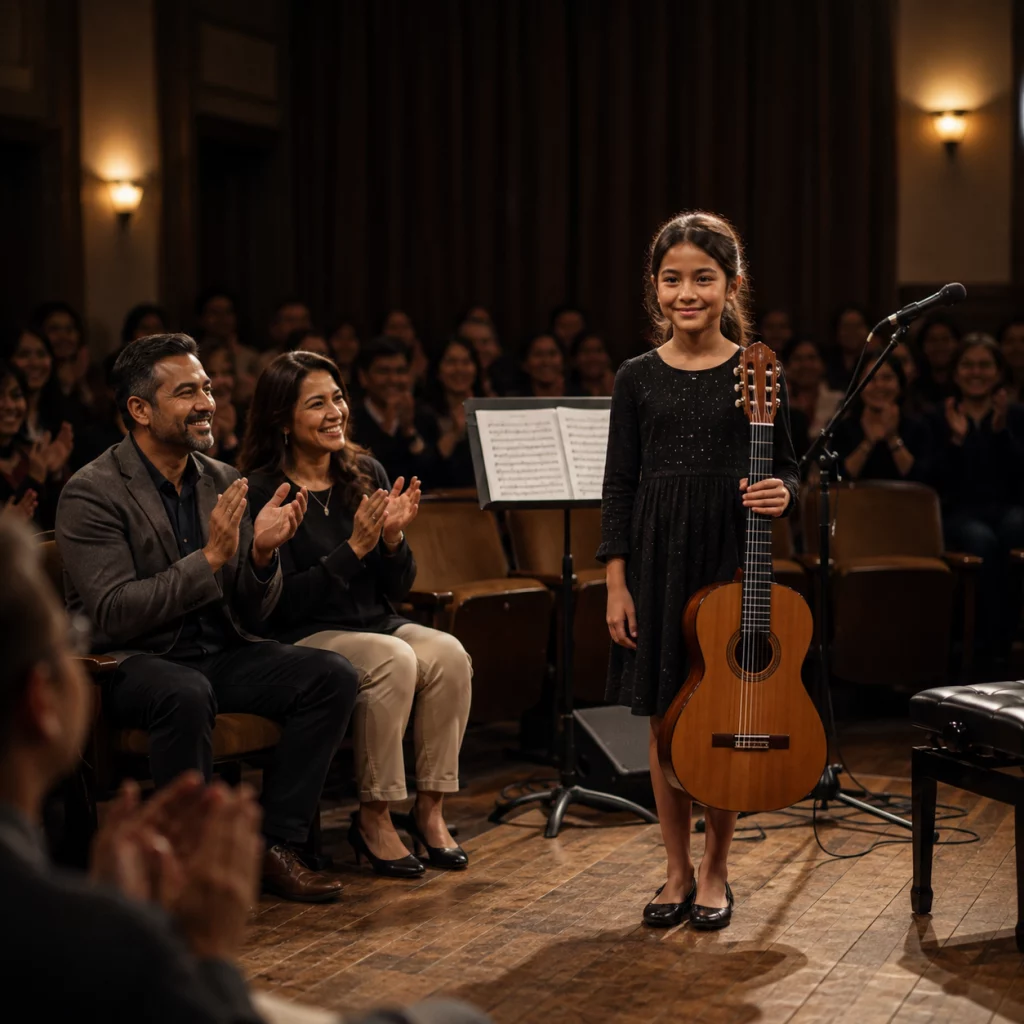
A beginner may feel proud after playing a complete song for the first time. Later, that same student may perform at a recital, complete an examination, join an ensemble, or master a piece that once seemed impossible.
Each milestone tells the child something important:
I struggled with this. I kept working. I improved.
That realization can be far more powerful than being told they are talented. It teaches children that confidence is not something they must wait to feel before taking action. Often, confidence comes afterward — as the result of preparation, persistence, and genuine accomplishment.
For parents, these moments can be especially rewarding. The applause after a recital is meaningful, but so is the quieter moment at home when a child finally plays the passage they have been working on all week and realizes, sometimes with surprise, that they can do it.
The Most Valuable Lessons Often Begin with Frustration
Every music student eventually encounters a point where progress feels slow.
A piece that was exciting at first becomes frustrating. Fingers do not move quickly enough. Notes are missed. Rhythm falls apart. The student may begin to wonder whether they are good at music at all.
Those moments are not signs that music lessons have failed. In many cases, they are where the most valuable learning begins.
With guidance from a teacher and encouragement from family, students gradually discover that mistakes are not permanent judgments. They are information. A missed note shows what needs attention. An uneven rhythm reveals where practice should slow down. A difficult section becomes manageable when it is divided into smaller parts.
Over time, children begin to understand that frustration does not always mean they should stop. Sometimes it means they are working at the edge of a new skill.
This is one reason the question “Are music lessons worth it?” cannot be answered only by looking at how quickly a child progresses. The value is also found in the way students learn to respond when progress is not immediate.
For families currently working through a difficult stage, our article Why Students Quit Music Lessons (And How Parents Can Prevent It) explores how realistic expectations, supportive routines, and the right learning environment can help children continue.
Music Gives Children a Place to Create
Not every benefit of music can be measured by marks, examinations, or performances.
For many children, music becomes something more personal. It offers a place to explore ideas, express emotions, and develop an individual artistic voice.
A student may begin by learning exactly what is written on the page. As their understanding grows, they may start interpreting a piece in their own way. They may experiment with dynamics, phrasing, rhythm, or tone. Some students become interested in improvisation or composition. Others discover that singing or playing an instrument helps them express something they cannot easily put into words.
Structured study also gives that creativity a foundation. Programs such as music theory and harmony help students understand how music is built, giving them more tools to interpret, arrange, and create it.
That balance between structure and imagination is part of what makes music education so valuable. Children learn that creativity is not simply waiting for inspiration. It can also grow through knowledge, practice, experimentation, and attention.
Learning Music Can Become a Shared Experience
Practice often begins as an individual activity, but music rarely remains solitary.
As students progress, they may perform in recitals, participate in bands and combos, collaborate with other musicians, or share what they have learned with family and friends.
These experiences change the meaning of practice. The student is no longer working only to complete an assignment. They are preparing to contribute to something larger.
Playing with others requires children to listen, adjust, and remain aware of the group. They learn that their part matters, but it must also fit with everyone else. They experience the responsibility of being prepared and the satisfaction of creating something together.
Music can also become part of family life. A child may play at a holiday gathering, accompany someone who is singing, or perform a piece for a grandparent. Years later, those moments may be remembered more clearly than any individual practice exercise.
Families can also visit the Ontario Conservatory of Music YouTube channel to see examples of students sharing music through live performances.
The Investment Can Continue Paying Off for Decades
Many childhood activities naturally end as children grow older. Music does not have to.
A student who begins lessons at age six may still be playing at sixteen, thirty-six, or seventy-six. They may perform professionally, join a community ensemble, play for personal enjoyment, teach someone else, or simply understand and appreciate music more deeply for the rest of their life.
Even students who eventually stop formal lessons often retain something important from the experience. They may remember how to read music. They may return to their instrument years later. They may become more thoughtful listeners, confident performers, or adults who understand what it takes to develop a skill over time.
The instrument itself may change. A piano student may later become interested in voice. A guitarist may begin writing songs. A violin student may eventually join an orchestra or explore another musical style.
The deeper benefit is that music remains available to them — as a creative outlet, a social connection, a source of enjoyment, and a skill they can continue developing at any stage of life.
Success Does Not Look the Same for Every Student
After nearly 90 years of teaching music, OCOM has watched generations of students begin with different interests, abilities, personalities, and goals.
Some students pursue formal examinations and advanced study. Some discover a love of performance. Some eventually teach. Others simply enjoy the satisfaction of playing music well enough to make it part of their lives.
These paths are different, but none of them should automatically be considered more successful than another.
A child does not need to become a professional musician for lessons to have been worthwhile. The student who becomes more confident, develops a strong work ethic, learns to persevere, and continues enjoying music into adulthood has gained something significant.
That is why the true value of music education cannot be measured only through certificates, awards, or technical ability. It is also reflected in the kind of learner a child becomes and the relationship with music they carry forward.
So, Are Music Lessons Worth It?
Every family has different priorities, schedules, and goals. No single extracurricular activity is right for every child.
However, music lessons offer something unusual: an immediate skill that can also create long-term value.
Children learn to play an instrument, but they also learn how to listen closely, practise consistently, recover from mistakes, express ideas, prepare for meaningful goals, and take pride in earned progress.
Years from now, your child may not remember every scale they practised or every exercise they completed. What they may remember is the feeling of finally mastering something they once thought was impossible, the applause after a first recital, the encouragement of a teacher who believed in them, and the quiet confidence that came from discovering what persistence could achieve.
That is the real return on the investment.
Families interested in exploring lessons can review OCOM’s music programs or visit the Getting Started page to learn more about choosing an appropriate program and beginning the enrollment process.
Frequently Asked Questions
Are music lessons worth the investment?
For many families, yes. Music lessons teach children how to play an instrument, but the benefits can extend much further. Students often develop confidence, discipline, perseverance, creativity, listening skills, and a lasting appreciation for music. The greatest value may not be a particular performance or examination result, but the habits and experiences a child carries into other areas of life.
What are the long-term benefits of music lessons?
Long-term benefits may include a lifelong creative outlet, greater confidence when approaching challenges, experience working toward meaningful goals, and the ability to participate in music throughout adulthood. Some students continue performing or studying formally, while others simply enjoy playing for themselves, their families, or their communities.
Does a child need natural talent to benefit from music lessons?
No. Natural ability may influence how quickly certain skills develop, but consistent practice, qualified instruction, realistic expectations, and family encouragement usually matter much more. A child does not need to be unusually gifted to develop musical skill or gain confidence, discipline, and enjoyment from the learning process.
Can music lessons help children become more confident?
Music lessons can help children build confidence through real achievement. Learning a song, overcoming a difficult passage, completing an examination, or performing for others gives students evidence that preparation and persistence lead to progress. That earned confidence can influence how they approach other challenges.
Is it too late for my child to start music lessons?
No. Children begin music lessons at many different ages. Readiness, interest, maturity, and the choice of instrument all matter more than finding one perfect starting age. OCOM offers programs for students at different stages, including preschool music and instruction for older beginners.
Further Reading
The ideas discussed in this article are supported by a growing body of research examining the cognitive, educational, and developmental benefits of music education. The following resources provide additional reading for parents who would like to explore the research in greater detail.
Research into music education is ongoing, and outcomes vary from one student to another. While studies suggest music training may support areas such as executive function, self-discipline, and other important learning skills, no single activity guarantees specific outcomes. The greatest benefits often depend on factors such as quality instruction, regular practice, family support, and a child’s individual interests and motivation.
- Executive Functions and Music Training
Sala, G., & Gobet, F. (2022). Music training, cognition, and academic achievement: A meta-analysis.
https://pmc.ncbi.nlm.nih.gov/articles/PMC9393548/ - Music Education and Executive Function
Frontiers in Psychology. Effects of Music Training on Executive Functions in Children.
https://www.frontiersin.org/ - National Association for Music Education (NAfME)
Research summaries exploring the educational and developmental benefits of music education.
https://nafme.org/ - The Royal Conservatory of Music
Articles and resources on music education, student development, and lifelong learning.
https://www.rcmusic.com/