
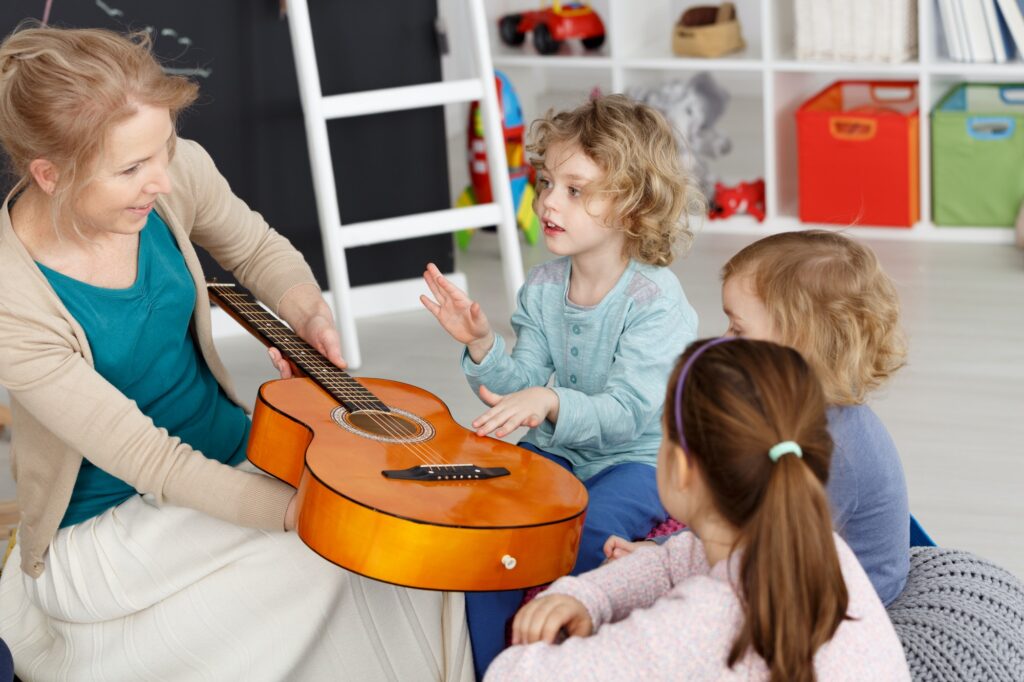
There are many good reasons as to why your child should learn to play an instrument. Numerous research studies have shown that learning from a very young age imparts valuable lifelong skills and is very helpful in aiding the child’s overall development in many ways.
Whether it’s guitar lessons, piano classes for kids or private violin lessons, learning to play a musical instrument provides many benefits for a growing child’s brain, physical and mental health and general well-being. In fact, research shows it’s the healthiest extra-curricular activity for kids, providing twice as much impact on a child’s development than sports, theater, or dance.
Here are top reasons why you should encourage your kids to play an instrument.
1. Facilitates cognitive development
Teaching kids to play a musical instrument stimulates brain activity, especially in areas related to problem solving, language, memory and concentration.
- Strengthens memory retention — Learning an instrument involves remembering notes, rhythms, and songs and managing other elements simultaneously. This helps boost retention and information processing, which is beneficial in school subjects, such as math or reading.
- Better attentiveness — Playing an instrument requires long periods of concentration and focus, which improves a child’s ability to pay attention to tasks, leading to less susceptibility to distractions.
- Improves critical thinking skills — Reading music and figuring out how to play guitar or piano stimulates both the left and right hemispheres of the brain. This helps improve skills like problem-solving, reasoning, and comprehension.
- Boosts language skills — Music and language share similar brain areas. Learning an instrument can enhance verbal memory, processing speed, and even literacy skills.
2. Improves emotional well-being
- Creative expression — Playing music is an outlet for children to express themselves, allowing them to articulate feelings, thoughts, and ideas in a way that sometimes words do not allow. It’s a way for them to communicate and share their individuality and authenticity with others. This helps them to develop emotional intelligence and resilience.
- Confidence — As students progress in their playing, they gain a sense of accomplishment. Performing in front of others also helps build self-esteem and reduces stage fright or performance anxiety.
- Patience and perseverance — Learning to play any type of instrument is challenging and requires persistence. Overcoming challenges on the path to progress fosters patience and teaches them how to deal with frustration and setbacks.
3. Promotes creativity
Music encourages creative expression. Children learning piano, violin,drums, guitar or other types can get inspired to think outside the box, explore new ideas and create their own music or compositions to express themselves.
4. Teaches discipline and time management
When learning any type of instrument, regular practice is crucial to progress and to achieve goals. This helps instill discipline, and students learn the importance of consistent effort. It also encourages better time management as they balance practice with school and other activities.
5. Builds social skills
Playing in a group (like a band or orchestra) teaches teamwork, communication, and how to collaborate with others to create something beautiful. It helps young kids build a connection with others whether they’re just playing with friends in a band or performing for an audience.
6. Provides a lifelong skill
It’s a skill they take with them throughout their life, whether they simply enjoy playing music as a hobby or choose to pursue it professionally as a composer or performer.
7. Supports academic performance
Many studies have shown that kids who learn music tend to perform better academically, especially in subjects like math and science. The pattern recognition, sequencing, and abstract thinking involved in learning music stimulates brain cells that translate into stronger academic skills.
What is the best age to learn a musical instrument?
A child can start learning instruments even at a young age, typically around 4 to 6 years old, but it greatly depends on the child’s interest and physical development. For example, some instruments like the piano and violin are often taught to children as young as 3 or 4, while others, such as the guitar or wind instruments, are more suitable for slightly older kids due to the physical requirements.
General Recommendations for Different Instruments
When should a child start guitar lessons?
Guitar classes for children typically start around 6-8 years old. However, some schools consider the best age to be ten years old and up, as children at this age have longer attention spans and a greater sense of self-discipline. Additionally, their hands are more physically developed to help them easily manipulate the strings and frets on the guitar.
What is a good age to start piano lessons?
Some experts recommend learning to play piano as early as 3-5 years old, while others say the ideal age is between 5 to 9 years old. Perhaps a good guide is that famous piano composers like Wolfgang Amadeus Mozart started to play piano at 3-years-old, and Ludwig van Beethoven started learning at age four! As long as young children have developed enough fine motor skills and the ability to focus as well as have the proper hand dexterity and finger coordination, then they are at the right age to effectively learn piano.
What age to start violin lessons
Most experts recommend starting violin lessons between the ages of 4 and 6 when children have developed good hand-eye coordination and the ability to follow simple instructions to learn effectively.
What age is ukulele for?
The general guideline is between the ages of 5 and 8. At this age, young kids possess the dexterity and cognitive abilities needed to grasp the basics of playing the ukulele. It’s a great first instrument for most kids due to its small size, which makes it easy for small hands to grasp. Additionally, its simple design with only four strings makes it one of the easiest instruments to learn for beginners.
In summary, the life-long benefits of learning music is more than just an after-school activity. If there is genuine interest, it may be the only justification you need for why your child should learn to play an instrument, and music classes and lessons are worth the investment in their future!