
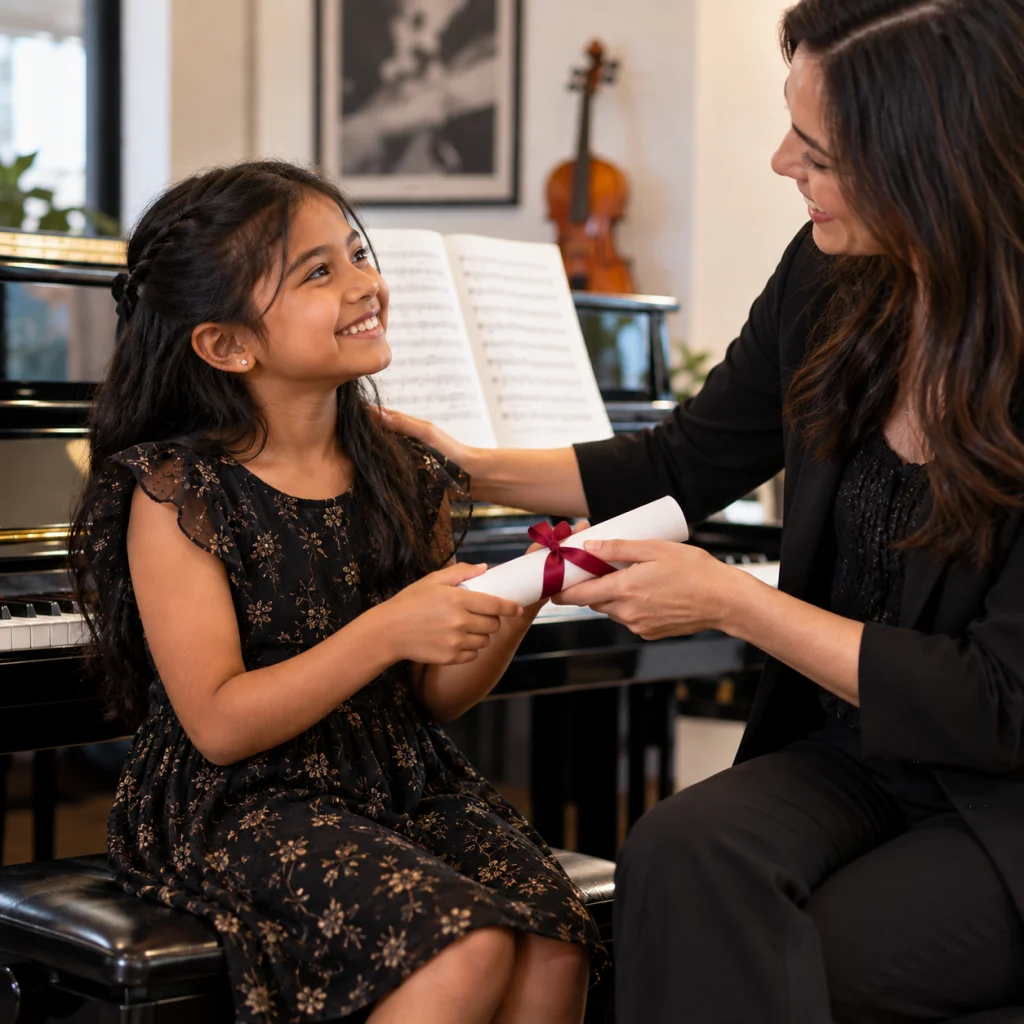
Confidence rarely appears overnight. For young musicians, it often develops gradually through practice, perseverance, and the satisfaction of accomplishing something that once seemed difficult.
Musical achievement provides students with opportunities to recognize their own progress. Learning a challenging piece, completing a music examination, performing for an audience, or mastering a new technique can give students tangible evidence of what they can accomplish through consistent effort.
These experiences matter because confidence is not simply about believing that you can succeed. It also comes from understanding how to work toward success, respond to challenges, and recognize improvement.
For parents, some of the most meaningful achievements may seem surprisingly small. A child who plays a piece without stopping for the first time may feel just as proud as an advanced student completing a formal examination.
At the Ontario Conservatory of Music, structured music education creates opportunities for students to work toward meaningful goals while developing the knowledge and skills needed to achieve them.
Understanding how musical achievement contributes to confidence can help parents recognize progress, encourage their children, and appreciate the value of a complete music education.
Why Musical Achievement Builds Confidence
There is an important difference between being told you are capable of something and discovering that capability through experience. A student learning a musical instrument encounters challenges regularly. New notes, unfamiliar rhythms, difficult passages, and increasingly complex pieces all require attention and practice. At first, a student may struggle to play even a short section correctly. However, with guidance and repetition, that same passage gradually becomes familiar. Eventually, the student can perform something that previously seemed beyond their ability. This creates a valuable connection between effort and achievement. Rather than relying entirely on encouragement from parents or teachers, students begin to recognize their own progress. They can hear the difference between how they played a piece last month and how they play it today. That sense of accomplishment can provide a foundation for approaching future musical challenges with greater confidence. Importantly, musical achievement does not have to involve competition, awards, or formal recognition. Personal improvement is an achievement in its own right.Small Musical Milestones Create Meaningful Progress
For beginners, musical achievements often occur long before their first recital or examination. A student might successfully identify notes on the staff, play with both hands, maintain a steady rhythm, or complete their first piece of music. These milestones can develop through violin lessons, piano study, and other instruments. Each milestone represents a new skill that the student did not previously possess. As students advance, their goals become more complex. They may begin interpreting musical expression, studying harmony, or preparing longer compositions. Examples of meaningful musical milestones include:- Playing a complete piece independently for the first time.
- Learning to read increasingly complex musical notation.
- Maintaining a consistent rhythm throughout a performance.
- Mastering a difficult passage after repeated practice.
- Playing music with another student or an ensemble.
- Completing a level of study or music examination.
- Performing a familiar piece with greater expression and control.
How Practice and Perseverance Strengthen Self-Belief
One of the most valuable lessons in music education is that difficult tasks can become manageable through consistent effort. Few students can play every new piece correctly on their first attempt. Even experienced musicians encounter unfamiliar techniques and challenging passages. Learning how to respond to these difficulties is an essential part of musical development.Learning to Work Through Challenges
Consider a piano student struggling to coordinate both hands. Initially, the student may practise each hand separately. With guidance from their teacher, they gradually combine the parts, beginning slowly and increasing the tempo as their coordination improves. The process requires patience, concentration, and a willingness to make mistakes. When the student finally plays the passage successfully, the achievement represents more than improved piano technique. It demonstrates that a challenge can be overcome through a thoughtful approach and sustained effort.Understanding That Mistakes Are Part of Learning
Students who expect immediate success may become discouraged when progress takes longer than anticipated. Music education offers repeated opportunities to develop a healthier understanding of mistakes. An incorrect note identifies something to practise. An uneven rhythm suggests where additional attention is needed. With constructive feedback, students can learn to view these difficulties as part of the process rather than evidence that they lack ability. Over time, successfully working through musical challenges may encourage students to approach unfamiliar tasks with greater confidence.The Role of Performances in Building Student Confidence
Performing music introduces an important new dimension to musical achievement. Playing an instrument during a lesson or at home is different from sharing that music with an audience. Even well-prepared students may feel nervous before a performance. Learning to manage those feelings while concentrating on the music can be a valuable educational experience.From Preparation to Performance
A recital gives students a clear goal. Families exploring performance preparation may also find value in learning about structured piano lessons. They must learn their music, refine their technique, practise performing without interruption, and prepare to share the finished piece. The performance becomes an opportunity to demonstrate what they have learned. For some students, the greatest achievement is performing an entire piece successfully. For others, simply completing their first recital represents an important personal milestone. Neither experience requires a flawless performance to be meaningful.Learning to Perform Despite Nervousness
Confidence does not necessarily mean feeling completely comfortable in front of an audience. A student can feel nervous and still deliver a successful performance. With experience, students may become more familiar with the preparation and concentration required for public performance. These experiences can also provide useful practice in presenting themselves before others, although confidence in musical performance does not automatically translate into confidence in every public-speaking situation. Parents can support this process by emphasizing preparation, courage, and improvement rather than perfection. Students may also gain valuable performance experience through bands and group music programs, where they learn to contribute to a shared musical result.Music Examinations and the Value of Recognized Achievement
Formal music examinations offer another way for students to measure their progress. Unlike an individual recital, an examination typically evaluates specific musical skills against established expectations. Depending on the examination, students may demonstrate prepared repertoire, technical exercises, and other aspects of musical knowledge. For students who are ready, examination preparation provides an opportunity to work toward a clearly defined goal.Why Examination Preparation Matters
The educational value of an examination extends beyond the final result. Students learn to organize their preparation, practise consistently, respond to feedback, and develop the skills required at their current level. Completing an examination can provide a meaningful sense of accomplishment because the student understands the effort involved. A successful result may also provide external recognition of progress that the student has already experienced through practice and instruction.Achievement Is More Than a Mark
Examination results can be useful indicators of musical progress, but they should not become the only measure of success. A student who improves significantly during preparation has accomplished something valuable, even if the final mark falls short of expectations. Similarly, a student who completes an examination despite feeling nervous may recognize an important personal achievement. The strongest educational approach uses examinations as part of a broader learning process rather than treating marks as the ultimate purpose of music education.How Structured Music Education Supports Achievement
Confidence grows more naturally when students have opportunities to experience progress at an appropriate pace. This is one reason a structured curriculum can be valuable. Rather than learning unrelated pieces without a clear progression, students work through musical concepts and techniques that build upon earlier knowledge. At Ontario Conservatory of Music, a comprehensive approach to music education includes instrumental study alongside subjects such as music theory, harmony, and music history. These subjects contribute to musical understanding in different ways. Theory helps students understand notation, rhythm, and musical structure. Harmony develops their understanding of how notes and chords work together. Music history provides context for the music they study and perform. As students develop this broader knowledge, they gain additional tools for approaching unfamiliar music. For example, a student who understands chord progressions may recognize patterns in a new piece rather than treating every note as an isolated challenge. This understanding can make increasingly complex musical tasks more approachable. Structured learning also provides teachers with opportunities to establish realistic goals, identify areas requiring additional attention, and recognize progress as students advance.How Parents Can Encourage Confidence Through Musical Progress
Parents play an important role in how children interpret their musical achievements. Encouragement is valuable, but the type of encouragement matters. Focusing exclusively on results, marks, or flawless performances can unintentionally suggest that only major accomplishments deserve recognition. Instead, parents can help children recognize the connection between effort, improvement, and achievement. Practical ways to support musical confidence include:- Recognize specific improvements. Instead of simply saying “good job,” mention the passage, rhythm, or technique that has improved.
- Celebrate smaller milestones. Completing a beginner piece or learning a difficult section deserves recognition.
- Encourage consistent practice. Help children establish manageable routines without turning every practice session into a test.
- Avoid comparisons with other students. Musical progress varies according to experience, preparation, individual strengths, and many other factors.
- Support performance opportunities. Encourage participation in recitals or group performances when the student is ready.
- Discuss challenges constructively. Ask what the student learned from a difficult experience and what they might try next.
- Recognize effort as well as results. A student who works diligently toward a challenging goal deserves encouragement, regardless of the final outcome.