
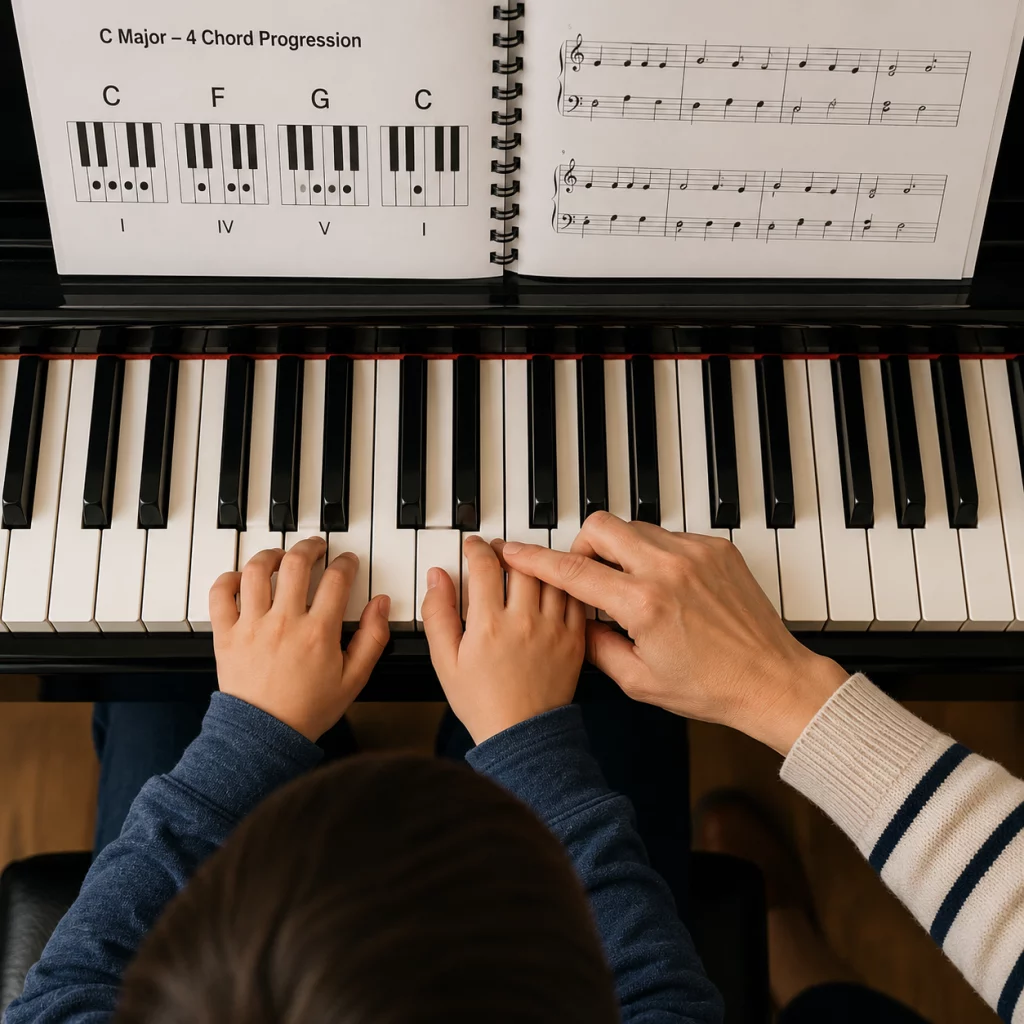
Your Child May Be Only a Handful of Chords Away from Playing a Song You Already Know by Heart
If you’re secretly hoping your child might eventually learn a few songs you recognize from your own playlist, you’re not alone.
Many parents imagine music lessons beginning with favourite songs, exciting performances, and familiar melodies. Instead, the first few weeks often sound… well… repetitive.
The same handful of chords.
The same simple exercises.
The same patterns played over and over again.
It’s perfectly natural to wonder:
“Why isn’t my child learning more songs?”
The answer is surprisingly reassuring.
Those first few chords aren’t random. They’re carefully chosen building blocks that help students develop confidence, coordination, and musical understanding. More importantly, they lay the foundation for playing a surprising number of recognizable songs while developing skills that will last a lifetime.
At the Ontario Conservatory of Music (OCOM), our teachers follow the Ontario Conservatory of Music and Royal Conservatory of Music Examination Grade Standards, helping students develop the theoretical, technical, and practical skills appropriate for each stage of their musical journey. Rather than memorizing one song after another, students learn the musical patterns that make those songs possible.
Why Don’t Music Teachers Start with Popular Songs?
Imagine teaching a child to read.
You probably wouldn’t begin with Shakespeare.
Instead, children first learn letters, then simple words, then short sentences before eventually reading entire books.
Music works in much the same way.
Rather than overwhelming beginners with dozens of different techniques, teachers introduce a small musical vocabulary first. Once students become comfortable with that vocabulary, everything else becomes much easier.
Chords are a big part of that vocabulary.
Learning just a handful of foundational chords allows students to:
- Strengthen finger coordination
- Develop proper hand positioning
- Recognize repeating musical patterns
- Accompany simple melodies
- Begin playing recognizable songs sooner than many parents expect
Although every instrument follows its own learning path, this gradual approach helps students build skills that will support them throughout their musical education.
The goal isn’t simply to teach students a few chords.
The goal is to give them a musical foundation they can continue building on for years to come.
Why Do Beginners Keep Playing the Same Chords?
Repetition can sometimes look like slow progress from the outside.
In reality, it’s often exactly the opposite.
Think about learning to ride a bicycle.
No one expects a child to ride confidently after balancing for only five minutes. The small skills have to become automatic before the bigger ones become possible.
Music is no different.
Every time students repeat a familiar chord progression, they’re developing several important skills at once:
- Finger strength
- Muscle memory
- Rhythm
- Listening skills
- Confidence
Eventually, they stop thinking about where their fingers belong and start thinking about how the music sounds.
That’s when real musical growth begins.
Parents sometimes worry that repetition means their child isn’t progressing.
In reality, repetition is often one of the clearest signs that meaningful learning is taking place. Each repetition reinforces good habits, making future lessons feel easier and allowing students to focus less on mechanics and more on making music.
A Small Musical Vocabulary Opens Big Doors
One of the easiest ways to understand chords is to compare them to language.
When children learn to speak, they don’t memorize every word in the dictionary.
Instead, they learn the words they use most often.
“Mom.”
“Dad.”
“Please.”
“Thank you.”
Those few words quickly grow into conversations.
Music follows the same pattern.
Teachers begin with some of the most useful chords because they appear frequently in music and connect naturally with one another. As students become comfortable with those foundational chords, they begin combining them in different ways to accompany an ever-growing variety of songs.
They’re not simply memorizing individual songs.
They’re building a musical vocabulary they can use throughout their musical lives.
Just as children eventually write stories using words they already know, music students eventually perform increasingly complex pieces using familiar musical building blocks.
Why Do So Many Songs Sound Similar?
Parents are often surprised to discover that many popular songs share similar chord progressions.
That doesn’t mean every song sounds the same.
Think about books.
Thousands of books use the same twenty-six letters of the alphabet, yet every story is completely unique.
Music works much the same way.
A relatively small collection of chords can be arranged in countless combinations to create songs that sound entirely different.
As students gain experience, they begin recognizing these musical patterns.
That ability to recognize patterns—not simply memorize individual songs—is one of the most valuable skills music education develops.
Even if parents never learn what terms like I-IV-V or I-V-vi-IV mean, understanding that music is built on patterns can make those early lessons feel much more purposeful.
The goal isn’t to teach students every possible chord right away.
The goal is to help them understand how music works.
When Students Recognize Their First Song
There’s a wonderful moment that happens with almost every beginner.
A student starts playing a familiar chord progression.
Then they suddenly stop.
Their eyes get a little wider.
“I know this song!”
That moment changes everything.
Instead of practicing isolated exercises, students begin connecting what they’ve learned to real music they recognize.
That excitement fuels motivation.
Motivation encourages practice.
Practice builds confidence.
Confidence leads to even greater progress.
It’s one of the reasons experienced music teachers carefully choose those early building blocks instead of rushing students toward more difficult material too soon.
How Chord Knowledge Helps on Every Instrument
Although the exact lessons vary depending on the instrument, the underlying philosophy remains the same: students build a strong musical foundation before tackling more advanced repertoire.
That’s one reason the Ontario Conservatory of Music teaches in accordance with the Ontario Conservatory of Music and Royal Conservatory of Music Examination Grade Standards. Students progressively develop theoretical, technical, and practical skills, giving them the confidence to perform music across many different styles.
Here’s how that foundation supports students in each program.
Piano Lessons
Piano students quickly discover that chords are much more than groups of notes.
They’re the building blocks of accompaniment, sight reading, improvisation, and eventually composing their own music.
As students become comfortable moving between familiar chord shapes, they begin recognizing those same patterns in the music they’re learning. Pieces that once looked complicated become much easier because students are no longer seeing isolated notes—they’re recognizing familiar musical ideas.
Guitar Lessons
For guitar students, learning a handful of common chords opens the door to accompanying songs surprisingly early in their musical journey.
While teachers continue developing proper technique, rhythm, and finger placement, those early chords allow students to experience the satisfaction of making real music almost immediately.
That early success often becomes a tremendous source of motivation, encouraging students to continue practicing as they build more advanced skills.
Ukulele Lessons
Ukulele is often recommended as a first instrument because several beginner chords are relatively comfortable to learn.
This allows students to focus on rhythm, timing, and musical expression while gradually expanding their chord vocabulary.
It’s an excellent example of how mastering a few carefully selected fundamentals can produce rewarding results very quickly.
Vocal Training
Even singers benefit from understanding chords.
Most vocal students aren’t expected to play every chord themselves, but recognizing chord changes helps develop stronger pitch awareness, better listening skills, and greater confidence performing with accompanists or backing tracks.
As students advance, that understanding makes rehearsals, performances, and ensemble singing feel much more natural.
Bands & Combos
One of the most exciting milestones in music education is making music with others.
Students who understand basic chord progressions are better prepared to accompany other musicians, participate in ensembles, and communicate using a shared musical language.
Those first few chords continue paying dividends long after students have moved beyond beginner lessons.
Patterns Matter More Than Memorization
Parents sometimes measure progress by asking how many songs their child has learned.
Music teachers often measure progress differently.
Instead of asking, “How many songs can this student play?”, they’re asking something much more important:
“Does this student understand what’s happening in the music?”
Those are very different questions.
A student who memorizes ten songs without understanding the patterns behind them may struggle when presented with an eleventh.
By contrast, a student who understands how chords work together can often learn new music much more efficiently because they recognize familiar relationships instead of starting from scratch every time.
This is also where studying music theory and harmony becomes so valuable. Students gradually discover why chords sound the way they do and how they work together to support melodies. That understanding gives them confidence whether they’re performing, accompanying another musician, or learning an entirely new piece.
That’s one reason conservatory-based instruction places so much emphasis on developing musical understanding alongside technical ability.
Students aren’t simply collecting songs.
They’re developing skills they’ll continue using for years.
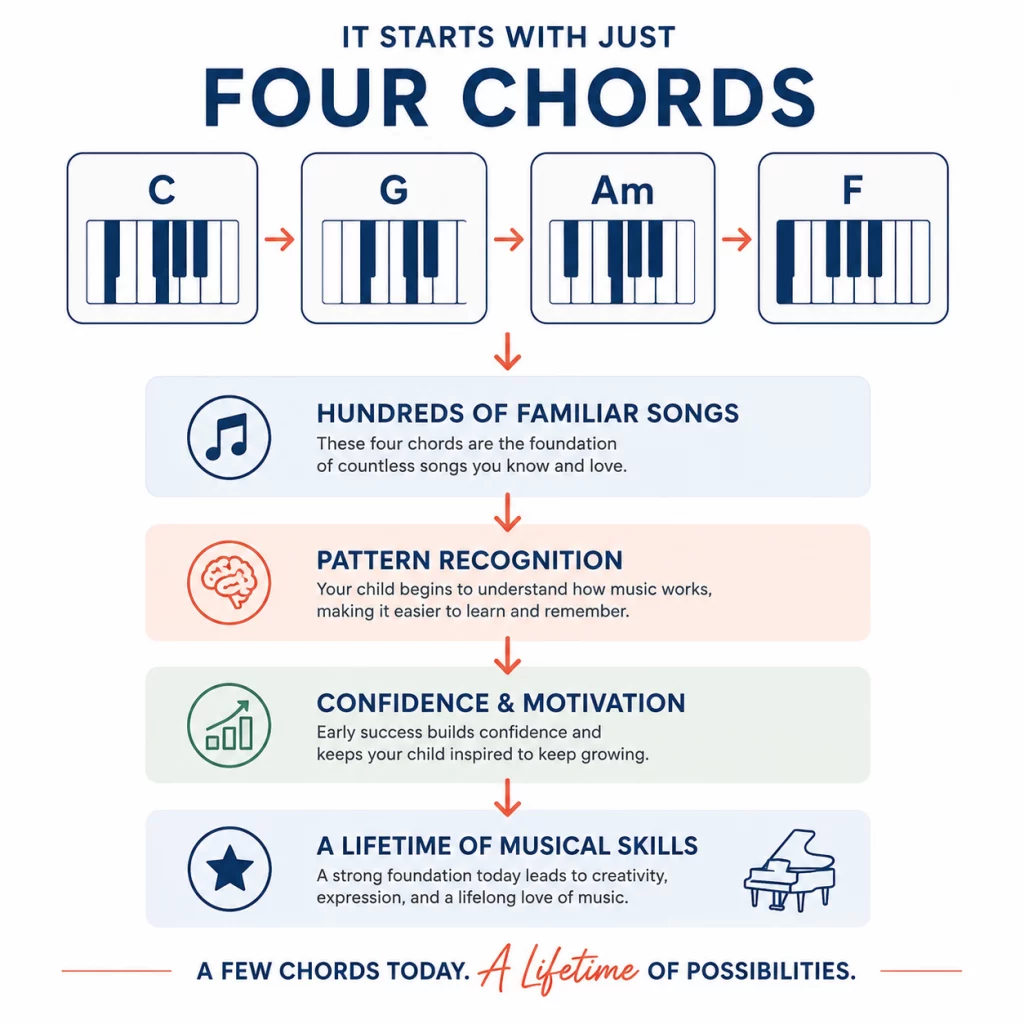
See the Concept in Action
Watching someone explain chord progressions can make this concept much easier to understand.
A simple demonstration shows how a small number of chords can be rearranged to accompany many familiar songs, helping parents understand why teachers spend so much time building these early foundations.
What This Means for Parents
If your child seems to be playing the same handful of chords over and over again, take it as a good sign.
It doesn’t mean lessons have stalled.
It usually means your child’s teacher is helping them develop skills that will make every future lesson easier.
Those early repetitions are building:
- Confidence
- Coordination
- Listening skills
- Musical understanding
- Pattern recognition
- Independence
Every new chord becomes another tool in your child’s musical toolbox.
Every familiar pattern makes the next challenge feel a little less intimidating.
Before long, those simple exercises begin transforming into recognizable songs, enjoyable performances, and the confidence to explore music independently.
The First Few Chords Are Just the Beginning
Learning music has never been about memorizing hundreds of songs.
It’s about learning the patterns that make music possible.
Just as children learn common words before writing stories, music students learn a handful of foundational chords before exploring increasingly complex pieces.
That careful progression isn’t accidental.
It’s part of a thoughtfully structured approach that helps students build lasting musical skills instead of relying on short-term memorization.
Unlike simply learning a collection of favourite songs, conservatory-based instruction develops theoretical, technical, and practical skills that continue growing from one level to the next. Students build a foundation that supports everything they learn in the future, regardless of the musical style they choose to pursue.
For nearly 90 years, the Ontario Conservatory of Music has helped students discover the joy of music through patient instruction, structured learning, and experienced teachers who understand that lasting success begins with strong fundamentals.
Those first few chords may seem simple today, but they’re often the beginning of a lifetime of musical enjoyment.
Ready to begin your child’s musical journey? Explore our music programs or visit our Getting Started page to learn how OCOM can help your child build confidence one lesson at a time.
Frequently Asked Questions
Why do music teachers start with only a few chords?
Teachers begin with a small number of foundational chords because they help students develop finger coordination, rhythm, confidence, and an understanding of musical patterns. Once these fundamentals become comfortable, learning new songs and more advanced techniques becomes much easier.
How many chords does a beginner need to learn?
There’s no magic number. Most beginners start with a handful of versatile chords appropriate for their instrument. As their confidence grows, teachers gradually introduce additional chords and more advanced musical concepts.
Do all instruments learn chords the same way?
No. Piano, guitar, and ukulele students often play chords directly from the beginning, while vocalists and other instrumentalists learn to recognize chord progressions and understand how harmony supports melody. Regardless of the instrument, learning how chords work together helps students become stronger musicians.
Why do so many popular songs use similar chord progressions?
Many songs are built from common musical patterns. Just as thousands of books are written using the same twenty-six letters of the alphabet, musicians can create an incredible variety of songs using familiar chord progressions. Learning to recognize those patterns helps students learn new music more quickly.
Will my child eventually learn more advanced chords?
Absolutely. Those first few chords are simply the beginning. As students progress through their lessons, they’ll expand their musical vocabulary, explore more sophisticated harmony, and perform increasingly challenging repertoire.
Does learning chords help with music theory?
Yes. Understanding chords gives students practical experience that supports what they learn in music theory and harmony. Together, these subjects help students become more confident performers, better listeners, and more complete musicians.