
Parents often look for activities that help children become more willing to try, speak up and work through challenges. Music education can provide that kind of environment because it combines clear instruction with regular opportunities to practise, improve and demonstrate a skill.
The connection between music education and confidence is not based on instant transformation. A child does not automatically become confident simply by enrolling in lessons. Confidence develops through experience. Students learn a small skill, practise it, receive feedback and eventually recognize that they can do something that once felt difficult.
After nearly 90 years of teaching music, Ontario Conservatory of Music has seen that students often become more assured when they can recognize their own progress. A finished piece, a corrected rhythm, a successful examination or a first recital can provide concrete evidence that effort produced improvement. Over time, those experiences can change how students approach the next challenge.
Confidence Begins with Competence
Children are more likely to feel confident when they know what to do and have had enough preparation to do it. Encouragement matters, but encouragement without instruction can feel empty. Structured lessons give students specific skills they can practise and use.
For a beginner, competence may mean recognizing notes, keeping a steady beat or playing a short passage with both hands. Later, it may involve interpreting a more difficult piece, singing with controlled breathing or performing as part of an ensemble. Each stage gives the student a new reason to trust their preparation.
This creates a practical cycle:
- The teacher introduces an achievable skill.
- The student practises it in manageable steps.
- Feedback identifies what is working and what needs attention.
- The student applies the correction and notices improvement.
- The completed task becomes evidence that another challenge can also be learned.
The process is especially valuable because the confidence rests on real ability. Students are not simply being told that they are capable. They are learning how capability is built.
Small Musical Goals Make Progress Visible
A large goal such as “learn piano” is too broad for a child to measure. Music teachers divide that goal into smaller tasks: learn four measures, correct a fingering pattern, maintain the rhythm or prepare one piece for a recital. Each completed step makes progress easier to see.
Visible progress matters when children become frustrated. A student who cannot yet play an entire piece may still be able to identify the section that improved this week. Teachers can reinforce that growth by giving precise feedback instead of general praise.
Examples of useful feedback include:
- “Your tempo stayed steady through that section.”
- “You corrected the note without being reminded.”
- “Your sound was more controlled today.”
- “You kept going after the mistake.”
- “You prepared every part of the assignment.”
Specific feedback helps students understand why something went well. It also gives them a clearer idea of what to repeat next time.
Parents can learn more about realistic musical progress in What We Have Learned After Nearly 90 Years of Teaching Music.
Practice Teaches Children to Work Through Difficulty
Music practice includes mistakes by design. A student plays, listens, adjusts and tries again. That can be uncomfortable, particularly for children who believe being “good” at something should mean getting it right immediately.
With patient instruction, mistakes become information rather than proof of failure. The teacher may slow the tempo, separate the hands, clap the rhythm or divide the music into shorter sections. The student learns that difficulty can often be made manageable by changing the approach.
This does not mean every practice session will feel positive. Children may still become impatient or discouraged. However, a consistent routine gives them repeated experience returning to a task and making it a little easier. That pattern can help students become more comfortable facing musical challenges instead of avoiding them.
For practical support when motivation drops, see Why Students Quit Music Lessons (And How Parents Can Prevent It).
Performance Experience Builds Familiarity with Being Seen
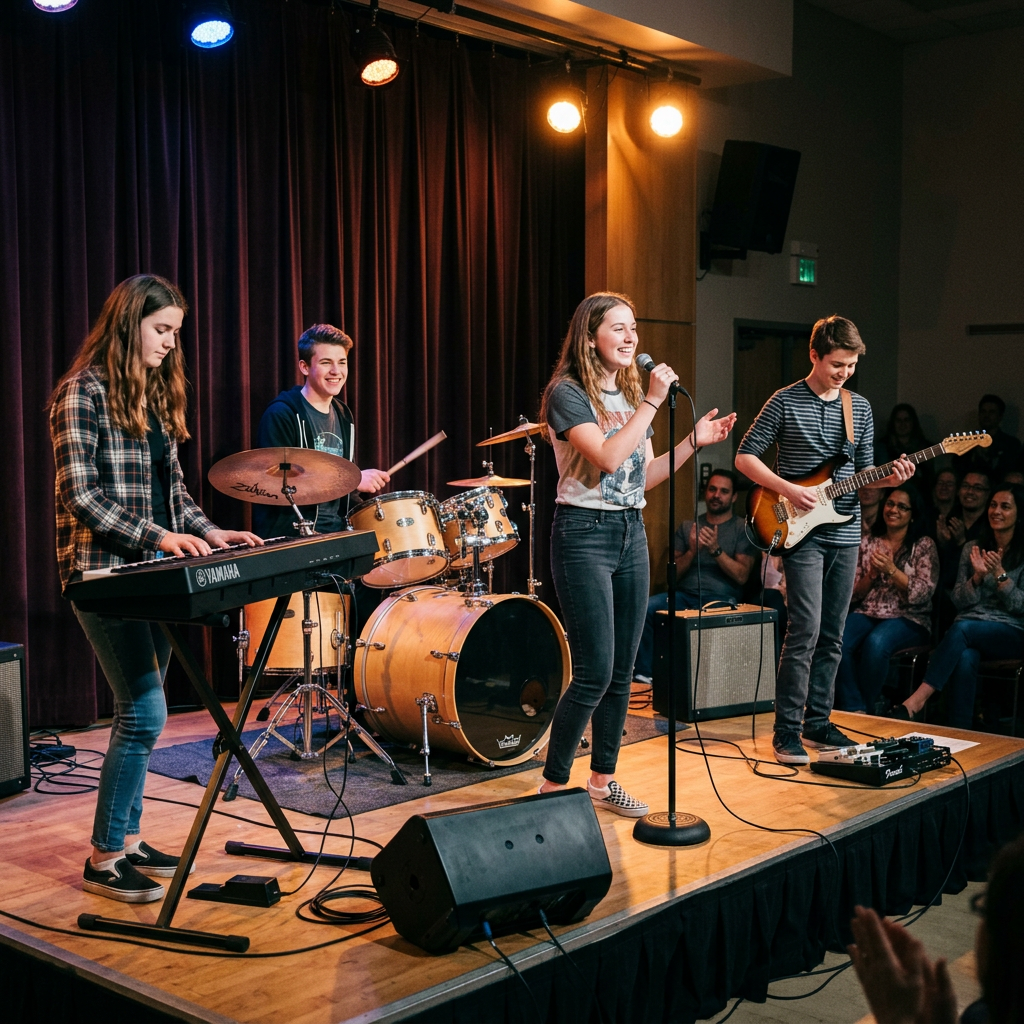
Performing for other people asks a student to use a prepared skill while being observed. That experience can feel intimidating, even when the audience is supportive. Recitals, concerts, examinations and informal class performances allow students to encounter that feeling in a structured setting.
The first goal is not to eliminate nervousness. Many experienced performers still feel nervous. Instead, students learn how to prepare despite those feelings, begin the performance and continue if something unexpected happens.
A successful first performance may include:
- preparing one suitable piece thoroughly;
- walking to the instrument or performance area;
- acknowledging the audience;
- starting without a teacher’s immediate assistance;
- recovering from a missed note or memory lapse; and
- finishing and accepting recognition for the effort.
Each performance makes the situation more familiar. A student who has played for family members, classmates and a recital audience has several examples of functioning while others are watching. That experience may support greater comfort in other presentation settings, although every child responds differently.
OCOM’s piano lesson program includes concerts, community recitals and annual competitions that give students progressive performance opportunities.
Music and Public Speaking Share Useful Skills
Playing an instrument is not the same as giving a speech, but the two experiences share important elements. Both require preparation, attention, recovery and communication in front of other people. Vocal students may also work directly with breathing, diction, projection and expression.
Through musical performance, children can practise how to:
- prepare for a specific date and audience;
- manage the opening moments of a presentation;
- focus while people are watching;
- continue after a small error;
- communicate mood or meaning; and
- evaluate the experience afterward without reducing it to “perfect” or “bad.”
Parents should view these as transferable experiences rather than guaranteed outcomes. A confident musician may still feel nervous speaking in class. Even so, music provides another setting in which a child can practise preparation and public presentation.
Group Music Creates Confidence Through Participation
Not every student wants to begin with a solo. Group lessons, bands, combos and ensembles can offer a different path. The attention is shared, and each student contributes one part to a larger result.
In a group, students listen, enter at the right time, adjust to others and continue even when the performance is not identical to rehearsal. They also see peers making corrections and working through the same learning process. That can make mistakes feel less isolating.
Group participation also gives students more than one way to contribute. One child may keep the rhythm steady, another may lead an entrance and another may help the group remember a transition. Recognizing a meaningful role can strengthen a student’s sense of musical competence.
Families can explore OCOM’s bands and combos program or read about the advantages of group music lessons.
The Teacher’s Response Shapes the Learning Environment
Confidence grows best in an environment that combines support with honest instruction. If work is always described as excellent, students may not know how to improve. If every mistake receives harsh attention, they may become reluctant to try.
A qualified teacher sets expectations that match the student’s current level, explains corrections clearly and recognizes real improvement. The teacher can also adjust the size of a challenge. A nervous beginner might first play for the teacher, then for a small group and later in a larger recital.
OCOM’s long-standing educational system uses structured curriculum, theory instruction and progressive performance goals to give learning continuity. Students can see how today’s assignment connects with a larger musical path rather than treating each lesson as an isolated activity.
Parents comparing programs may find Choosing Music Classes for Kids: A Parent’s Guide helpful.
How Parents Can Support Confidence Without Adding Pressure
Parents influence how children interpret both progress and mistakes. Supportive involvement does not require musical expertise. It requires attention to the process.
Parents can help by:
- protecting a regular practice time;
- recognizing preparation and persistence;
- asking what improved rather than whether the piece was perfect;
- allowing the teacher to handle technical correction;
- keeping recital expectations appropriate to the student’s level;
- avoiding comparisons with siblings or other students; and
- celebrating the courage to participate as well as the final result.
After a performance, ask questions such as “What felt easier than you expected?” or “What would you prepare differently next time?” These questions help the child reflect without making approval depend on a flawless result.
Signs That Musical Confidence Is Growing
Confidence does not always look loud or outgoing. A quiet student may be making important progress without becoming eager for the spotlight. Parents and teachers can look for behavioural signs connected directly to learning.
A student may be developing confidence when they:
- begin a familiar task without waiting for reassurance;
- attempt a difficult passage before asking for help;
- identify and correct some of their own mistakes;
- accept constructive feedback without giving up;
- volunteer to play for a teacher, family member or small group;
- continue after making an error; and
- set a new musical goal after completing the last one.
These changes may appear gradually and will vary by personality. The aim is not to turn every student into an enthusiastic solo performer. It is to help each child become more secure in using the skills they have developed.
Frequently Asked Questions
Can music lessons make a shy child more confident?
Music lessons can give a shy child structured opportunities to learn, improve and perform, but they do not guarantee a personality change. Confidence may first appear in small ways, such as playing for the teacher, attempting a difficult passage or participating in a group. A gradual pace and supportive environment are especially important.
Does a child have to perform in recitals to build confidence?
No. Confidence can develop through lessons, home practice, examinations and informal performances. Recitals provide a useful goal and experience with an audience, but readiness differs. Teachers can introduce performance gradually and choose an opportunity that fits the student’s current skill and comfort level.
What if performing makes my child nervous?
Nervousness is common and does not necessarily mean the child should avoid performing. Preparation, suitable repertoire and smaller audiences can make the experience more manageable. The goal is not to promise that nerves will disappear. It is to help the student prepare, begin and recover if something goes differently than expected.
Are group or private lessons better for confidence?
Both can help in different ways. Private lessons provide individual feedback and allow the teacher to adjust the pace closely. Group lessons let students participate with peers, share attention and contribute to an ensemble. The best format depends on the child’s learning needs, goals and comfort with others.
How can parents praise musical progress effectively?
Use specific observations instead of broad statements. Mention the steady rhythm, improved posture, corrected note or willingness to keep going after a mistake. Specific praise shows the child what their effort accomplished and helps them understand which habits support continued progress.
Confidence Grows One Accomplishment at a Time
Music education and confidence can grow together because music gives children repeated opportunities to prepare, attempt, adjust and improve. A student learns that a difficult passage can become manageable, a mistake does not have to end a performance and consistent work can lead to an observable result.
Those lessons are most effective when expectations remain realistic. Children need qualified instruction, achievable goals, constructive feedback and enough time to develop at their own pace. The objective is not to create a fearless performer. It is to help the student become increasingly secure in their preparation and willing to use what they have learned.
Families can explore OCOM’s music programs, find a nearby Ontario Conservatory of Music location or visit Getting Started to ask which learning environment may suit their child.