
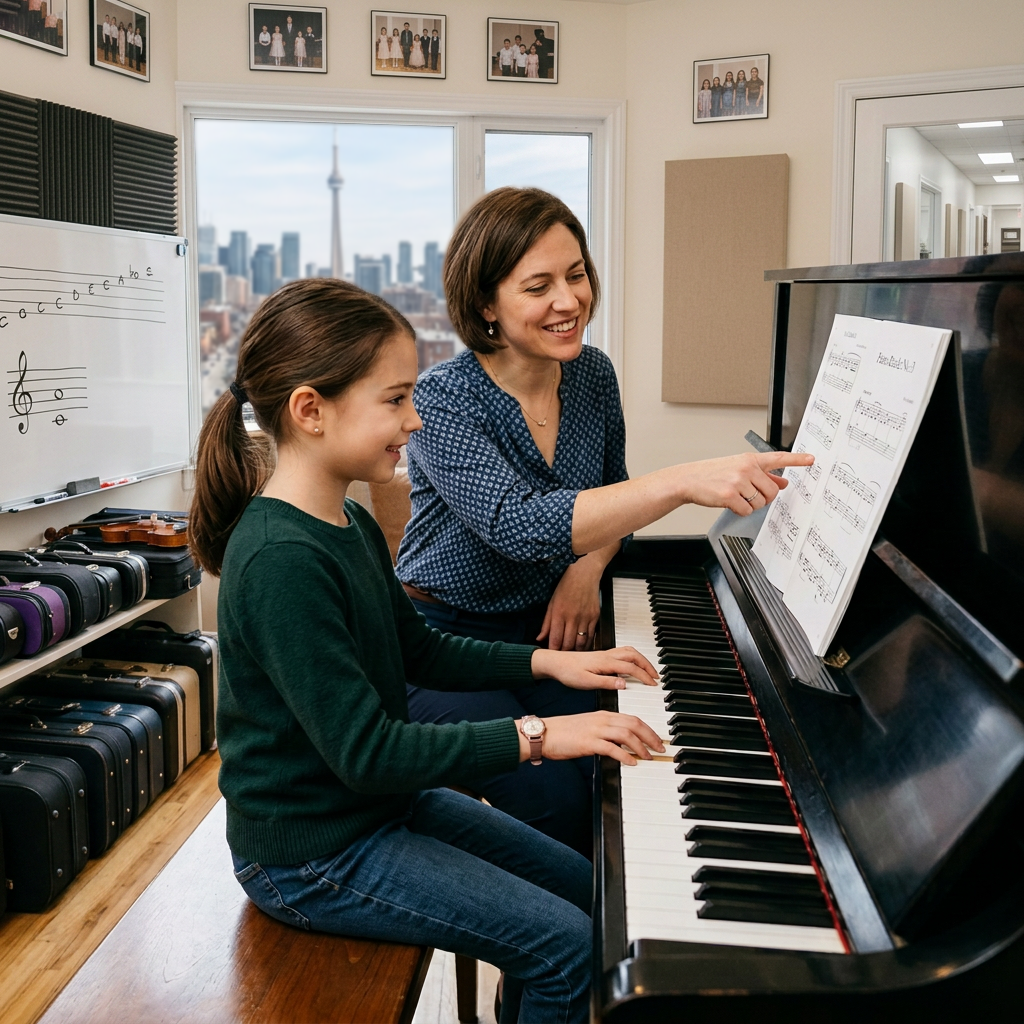
Choosing piano lessons in Toronto involves more than finding an available teacher at a convenient time. Parents are choosing the environment, curriculum, and guidance that may shape how their child understands music for years. A positive personality fit matters, but so do the teacher’s qualifications, the structure behind the lessons, and the opportunities available as the student progresses.
Toronto families have many options, including independent teachers, retail-store lesson programs, community programs, and established music schools. Each can suit different goals. The useful question is not simply, “Which school is best?” It is, “Which program offers the right combination of instruction, accountability, flexibility, and long-term direction for this student?”
Ontario Conservatory of Music has taught students since 1939. Over that time, one pattern has remained consistent: students are more likely to make steady progress when families understand what a program teaches and how it supports learning between lessons. The following criteria can help parents compare a piano teacher or music school in Toronto with greater confidence.
Start With Your Child’s Goals and Readiness
Before comparing schools, consider what the student hopes to gain. A young beginner may need an encouraging introduction to rhythm, notation, listening, and keyboard geography. Parents who are unsure about readiness can begin by considering what age a child should start piano lessons. An older student may want to learn favourite songs, prepare for examinations, join an ensemble, or build the foundation for advanced study. Adults may be returning to music or starting for personal enjoyment.
A good school should ask about the student rather than placing everyone into an identical path. Age matters, but readiness also includes attention span, communication, interest, and the ability to follow simple instructions. Parents should be able to explain their goals while remaining open to an educator’s assessment of the most appropriate starting point.
During an initial conversation, ask:
- What does a beginner learn during the first several months?
- How does the program adapt to different ages and experience levels?
- How are short-term goals connected to long-term musical development?
- What support is available if the student’s interests or pace change?
Look Closely at Piano Teacher Qualifications
The phrase “piano teacher Toronto” can describe people with very different backgrounds. Some are accomplished performers. Others have formal education in music or extensive teaching experience. Performance ability is valuable, but teaching also requires patience, communication, lesson planning, and the ability to explain the same idea in several ways.
Parents should ask how a school selects, trains, and supports instructors. Relevant questions include whether teachers have formal music education, what levels they teach, whether they can teach theory, and how the school maintains consistency if a teacher changes. These considerations are explored further in OCOM’s guide to choosing the right music teacher. A well-organized school should answer clearly without dismissing the importance of a warm relationship between teacher and student.
At OCOM, teaching staff are university educated, and teaching management oversees student programs. That combination helps connect individual instruction with a broader educational system. However, qualifications alone do not guarantee the right fit. The student should also feel comfortable asking questions, trying difficult passages, and making mistakes during the learning process.
Compare the Curriculum, Not Just the Lesson Length
Two 30-minute lessons can offer very different educational value. Ask what the curriculum includes and how skills build from one level to the next. Strong piano instruction normally develops more than the ability to reproduce a piece from memory.
A well-rounded program may include:
- Correct posture, hand position, and healthy playing habits
- Reading music and understanding rhythm
- Scales, chords, technique, and coordinated movement
- Ear training and careful listening
- Music theory and vocabulary
- Repertoire chosen for the student’s level and goals
- Practice strategies and achievable weekly assignments
- Performance or examination preparation when appropriate
Theory is especially worth asking about. Students benefit from understanding patterns, keys, intervals, rhythm, and harmony rather than treating each piece as an unrelated set of notes. OCOM teaches a structured curriculum that includes its own educational system and the Royal Conservatory syllabus. This gives students a path from beginner concepts toward more advanced musicianship without requiring every student to pursue the same destination.
Ask How Progress Is Communicated
Musical progress during the first year of lessons rarely follows a perfectly straight line. A student may improve quickly in reading while needing more time with rhythm or technique. Parents need enough information to support practice without turning every session at home into a test.
Ask how the school records assignments, shares teacher observations, and discusses concerns. OCOM provides weekly progress reports after lessons, which can help parents understand what was covered and what to reinforce during the week. Other schools may use notebooks, online portals, emails, or scheduled conferences. The format matters less than having a reliable process.
Good communication should also work in both directions. Parents should know whom to contact about scheduling, motivation, teacher fit, or changing goals. Meanwhile, older students should gradually learn to take more responsibility for their own practice and questions.
Consider Performance and Examination Opportunities
Not every student wants to perform publicly or complete formal examinations. Still, it is useful to know what opportunities a school can provide. Recitals, group classes, ensembles, and examinations can give students a clear goal and a reason to prepare music carefully.
Ask whether participation is optional, how students prepare, and whether opportunities suit different comfort levels. A first performance should feel achievable. Some students are ready to play in a recital; others may begin by performing for a small class or recording a completed piece.
For families interested in Royal Conservatory examinations, ask whether teachers understand the current requirements and can prepare students in repertoire, technique, ear training, and theory. Examination preparation should be part of a complete education, not a race through levels. The goal is for the student to develop the skills represented by the level, not simply reach the test date.
Evaluate the School’s Experience and Educational System
School longevity does not automatically make a program right for every family. However, a long operating history can show that the school has had time to develop curriculum, teacher support, progress systems, and pathways for students at different stages.
OCOM was founded in Toronto in 1939 and has continued teaching through major changes in music education, family schedules, technology, and student interests. Nearly nine decades of teaching music have reinforced a practical lesson: consistency usually matters more than quick bursts of enthusiasm. Students need appropriate challenges, regular piano practice, clear feedback, and adults who treat gradual progress as normal.
When comparing any music school in Toronto, ask what happens beyond the first year. Can the program continue through intermediate and advanced study? Does it include theory, harmony, history, group instruction, examination preparation, or teacher training for students who become interested in those areas? A school does not need to offer every option, but it should be honest about the path it can support.
Balance Location and Schedule With Educational Quality
Convenience matters. A strong program is difficult to sustain if travel and scheduling create weekly stress. Toronto traffic, school commitments, sports, and family routines all affect attendance and practice.
At the same time, the nearest option is not automatically the best fit. Consider the full weekly commitment: travel time, lesson length, expected practice, make-up policies, and communication. OCOM has Toronto-area campuses and locations throughout Southern Ontario, including North York, Downsview, Victoria Park, and Rexdale. Families can compare locations while still looking for a consistent educational approach.
Before enrolling, confirm the current schedule and location details directly with the school. If possible, visit the learning environment. Notice whether it feels organized, welcoming, and suited to focused instruction.
Use a Simple Process to Compare Piano Lessons in Toronto
Parents do not need to become music-education experts before making a decision. A short, consistent process makes comparisons easier:
- Define the student’s age, experience, interests, and likely goals.
- Shortlist schools or teachers that offer a suitable location and schedule.
- Ask the same questions about qualifications, curriculum, theory, progress reporting, and future levels.
- Discuss the recommended program and what families should expect during the first term.
- Consider both the student-teacher connection and the system supporting the lessons.
- Review progress after the student has had enough time to settle into a routine.
Be cautious of guarantees about rapid advancement or specific outcomes. Progress depends on many factors, including readiness, attendance, practice, instruction, and the difficulty of the goals. A trustworthy educator should set realistic expectations and explain how progress will be assessed.
Frequently Asked Questions About Piano Lessons in Toronto
How do I know whether a piano teacher is qualified?
Ask about formal music education, teaching experience, the levels taught, and the teacher’s ability to teach theory as well as practical piano skills. Also ask how the school selects and supervises instructors. Qualifications matter, but observe whether the teacher communicates clearly and creates an environment where the student feels comfortable learning.
Should I choose a private teacher or a music school?
Either can work well. An independent teacher may offer a close, flexible relationship. A music school may provide a structured curriculum, administrative support, substitute or transition options, recitals, group programs, and a longer pathway of study. Compare the actual teacher and program rather than assuming one model is always better.
Do beginners need to study music theory?
Beginners do not need advanced theory, but they should gradually learn the ideas behind what they play. Basic notation, rhythm, intervals, scales, chords, and musical terms help students read more independently and recognize patterns. Theory works best when teachers connect it directly to pieces and practical piano skills.
Are Royal Conservatory examinations required?
No. Examinations can provide structure, feedback, and recognized milestones, but they are not the only reason to study piano. Families should discuss whether examinations fit the student’s goals and temperament. If a student chooses that path, preparation should include the full range of required skills rather than focusing only on repertoire.
How important is a school’s location?
Location matters because regular attendance supports consistency. However, families should weigh convenience alongside teacher fit, curriculum, communication, and long-term options. A slightly longer trip may be worthwhile for a better program, but a schedule that creates constant stress can make even excellent lessons difficult to sustain.
Choosing a Toronto Music School With Confidence
The right choice for piano lessons in Toronto should fit the student now while leaving room for growth. Look for qualified instruction, a clear curriculum, age-appropriate expectations, useful parent communication, and opportunities that match the student’s interests. Then consider whether the location and schedule make consistent participation realistic.
Families exploring Ontario Conservatory of Music can learn more about getting started. An initial program consultation can help clarify the student’s readiness, interests, and suitable next steps.